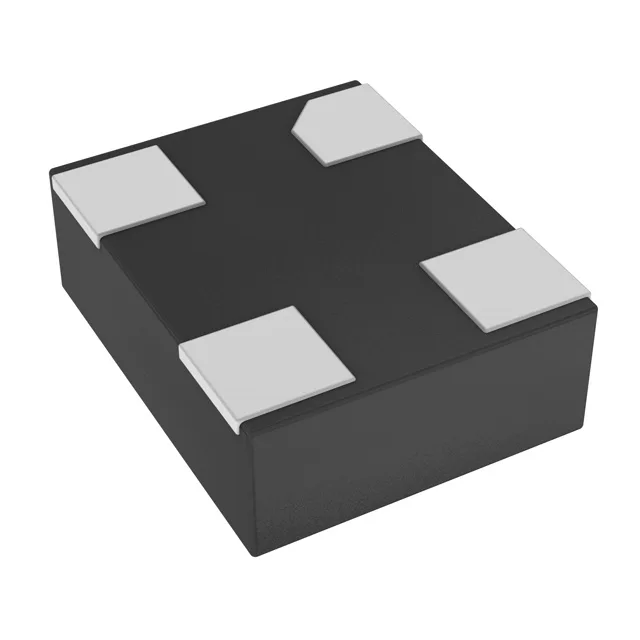
Microchip Technology DSC1001DI1-010.0000T — Crystals & Oscillators

DSC1001DI1-010.0000T MEMS Oscillator 10 MHz AEC-Q100 CMOS

MPNDSC1001DI1-010.0000T
Active

Microchip Technology DSC1001 series MEMS XO (Standard), 10.0000 MHz, CMOS output, 4-SMD no-lead package, AEC-Q100 qualified, standby (power down) function, -40°C to 85°C operating range.

$0.8850Ref. price · indicative, final on quote
Independent supplier — new & surplus stockAuthenticity-screened · ESD-safe packingListing updated Aug 2026

Specifications

DSC1001DI1-010.0000T specifications
ParameterValue
TypeXO (Standard)
SeriesDSC1001
MountingSurface Mount
Supply voltage1.8V ~ 3.3V
Current - supply6.3mA
Current - supply (Disable)15µA
Frequency10 MHz
Frequency stability±50ppm
Operating temperature-40°C~85°C
Size (Dimension)0.098\" L x 0.079\" W (2.50mm x 2.00mm)
Height - seated0.035\" (0.90mm)
OutputCMOS
PackageTape & Reel (TR)
RatingsAEC-Q100
FunctionStandby (Power Down)
Base resonatorMEMS
Case4-SMD, No Lead

Product details

AEC-Q100 MEMS oscillator at 10 MHz

The DSC1001DI1-010.0000T is a Microchip MEMS-based XO (Standard) delivering a 10 MHz CMOS output in a 2.50 mm × 2.00 mm 4-SMD no-lead package.

Standby power-down saves 15 µA

In a battery-backed ECU or a key-off always-on module, that 15 µA leakage is lower than the self-discharge of a coin cell — the oscillator stops consuming the 6.3 mA active current when the system sleeps.

Listed as Active by Microchip.

Frequently asked questions

Is the DSC1001DI1-010.0000T suitable for automotive applications?

Yes.

Does the DSC1001DI1-010.0000T have a pin-compatible replacement if discontinued?

No pin-compatible replacement is listed by Microchip. The DSC1001 series is currently Active, so no immediate successor is needed. If a cross is required later, the same DSC1001 base number at the same frequency and package footprint is the direct path.

How does this MEMS oscillator compare to a standard quartz oscillator in jitter?

The evidence does not provide jitter figures for this part. MEMS oscillators generally have higher phase noise than quartz at very close-in offsets, but they offer better shock and vibration immunity and faster startup — the trade-off is application-dependent.