What the AEC-Q100 rating means for your board
That qualification makes it a drop-in fit for automotive body controllers, infotainment head units, or ADAS sensor modules where the clock source must survive the thermal and vibration profile of a vehicle interior or under-hood environment.
36.667 MHz fixed frequency — no programmability
The output is a fixed 36.667 MHz CMOS clock — no I²C or pin-strap programming. The BOM position is locked to this frequency; if your design needs a different frequency, the DSC1001 family covers a range of values, but this exact order code is a single-frequency SKU.
A standby (power-down) pin on the 4-SMD package pulls the oscillator into a low-power state drawing a maximum of 15 µA. For battery-backed or ignition-off modules, the standby current is low enough to avoid draining a coin cell or supercap during extended sleep periods.
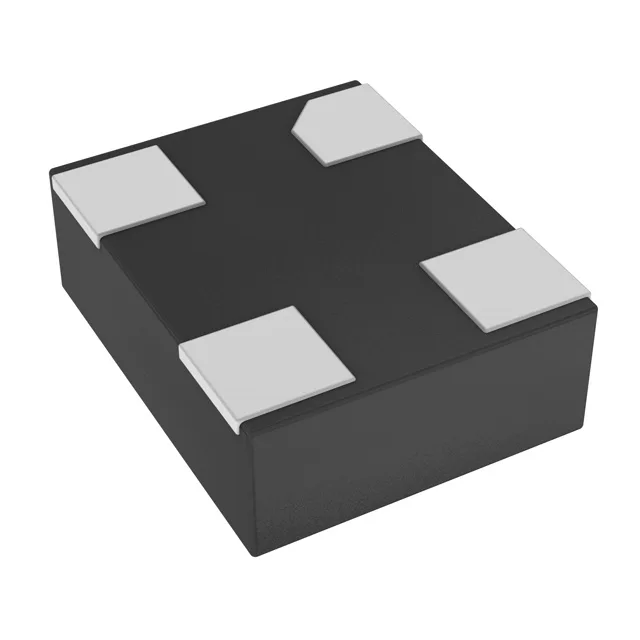
The 4-SMD no-lead package measures 2.50 mm x 2.00 mm with a seated height of 0.90 mm. No exposed thermal pad — the four pads are on the bottom face. The package outline is small enough that a standard 3 mm nozzle covers all four pads simultaneously.