12.5 MHz CMOS XO with AEC-Q100 qualification
For an engine-control or body-control module that sees -20°C to +70°C ambient (the listed operating range,), the MEMS die handles the vibration profile without the frequency glitch a quartz crystal can produce at resonance.
Supply tolerance and power budget
The 1.8V to 3.3V supply range covers the common automotive logic rails — 3.3V for the main MCU, 1.8V for the CAN transceiver or sensor interface — without an external LDO just for the oscillator. Maximum active current is 6.3 mA, which is low enough that the thermal rise inside a sealed ECU enclosure stays negligible.
Package footprint and board layout
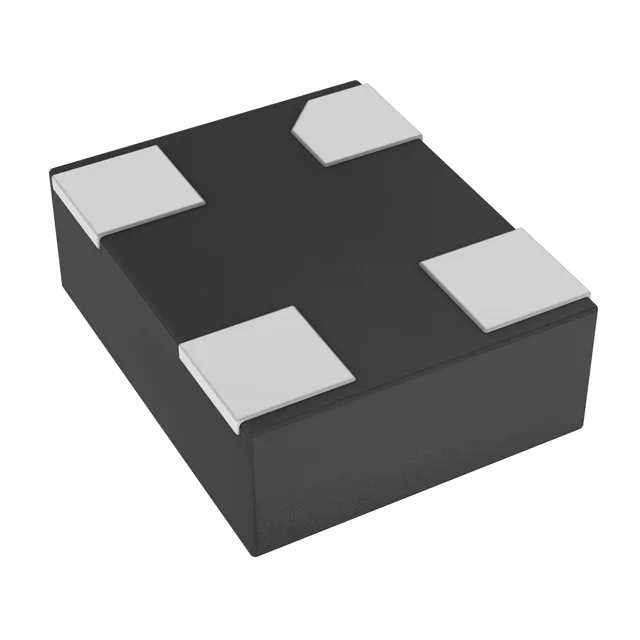
The 2.50 mm x 2.00 mm 4-SMD no-lead package is a compact ceramic or plastic land-grid — no leads to solder, just a pad pattern on the PCB. Seated height is 0.90 mm max, so it fits under a 1.0 mm clearance on the opposite-side component. The small footprint means the decoupling capacitor (a 0.1 µF X7R in the 0402 or 0603 size) can sit directly adjacent to the Vdd pad, keeping the loop inductance low. No exposed thermal pad — the heat path is through the solder joints and the board copper.
Microchip lists no official successor or cross-reference for the DSC1001DE1-012.5000T; the base product number DSC1001 covers the full frequency and stability variants.