Why pick a MEMS oscillator over a quartz can?
For a field-service swap or an automotive ECU that sees potholes, that is a real reliability edge. It is a standard XO (oscillator) with CMOS output, so it drops straight into any digital clock input expecting a square wave — no external load caps or feedback resistor needed. The 60 MHz frequency with ±10 ppm stability keeps the clock edge jitter tight enough for CAN-FD, 100BASE-T1 Ethernet, or a high-speed MCU PLL reference.
This part carries AEC-Q100 qualification — the automotive IC stress test that covers temperature cycling, ESD, and latch-up. If your BOM calls for under-hood (125°C), you need the wider-range sibling.
Supply voltage flexibility — one part, three rails
The 1.8V to 3.3V supply range means this single order code covers 1.8V, 2.5V, and 3.3V logic families. No need to qualification three different fixed-voltage oscillators — one line item on the BOM, one reel in the kit.
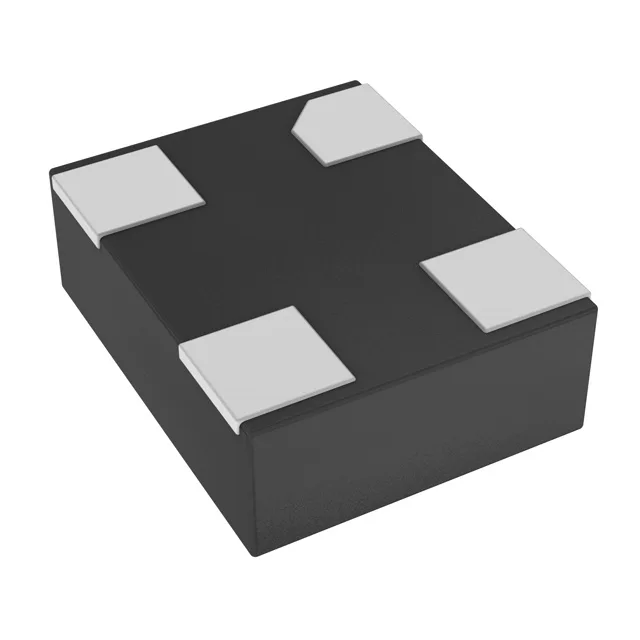
It comes in a 4-SMD, no-lead package measuring 3.20 mm x 2.50 mm, seated height 0.90 mm max. Surface-mount only — no through-hole variant. No polarity risk if you follow the silkscreen dot.