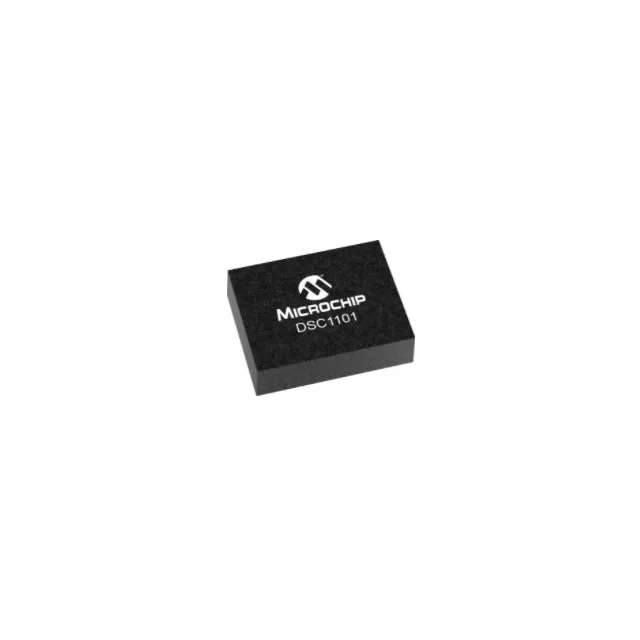
Microchip Technology DSC1001CI5-015.0000T — Crystals & Oscillators

DSC1001CI5-015.0000T – Microchip MEMS Oscillator, 15 MHz

MPNDSC1001CI5-015.0000T
Active

Microchip Technology DSC1001CI5-015.0000T, XO (Standard) MEMS oscillator, 15 MHz, CMOS output, ±10 ppm stability, 1.8V–3.3V supply, -40°C to 85°C, AEC-Q100, 4-VDFN package.

Sourced new & surplus through independent channelsAuthenticity-screened · ESD-safe packingListing updated Aug 2026

Specifications

DSC1001CI5-015.0000T specifications
ParameterValue
TypeXO (Standard)
SeriesDSC1001
MountingSurface Mount
Voltage1.8V ~ 3.3V
Current - supply8mA
Current - supply (Disable)15µA
Frequency15 MHz
Frequency stability±10ppm
Operating temperature-40°C~85°C
Size (Dimension)0.126\" L x 0.098\" W (3.20mm x 2.50mm)
Height - seated0.035\" (0.90mm)
OutputCMOS
PackageTape & Reel (TR)
RatingsAEC-Q100
FunctionStandby (Power Down)
Base resonatorMEMS
Case4-VDFN

Product details

It operates from a 1.8V to 3.3V supply and draws 8 mA max at 15 MHz, with a standby current of just 15 µA when the power-down function is enabled. The MEMS resonator inherently handles mechanical shock better than a quartz crystal — no startup reliability surprises on a hot engine bay or a factory floor.

Package and supply flexibility for tight boards

Housed in a 4-VDFN package measuring 3.20mm x 2.50mm with a seated height of 0.90mm, this oscillator fits into space-constrained layouts common in automotive ECUs and portable equipment. Frequency stability of ±10 ppm ensures reliable clocking for serial interfaces like CAN, SPI, and UART over the full temperature range. No external load capacitors are needed — the MEMS oscillator is self-contained, unlike a quartz crystal that requires two caps and a feedback resistor.

Frequently asked questions

Does DSC1001CI5-015.0000T require external components like load capacitors?

No. Because it is a MEMS-based oscillator (not a quartz crystal), the DSC1001CI5-015.0000T is self-contained. It requires only a power supply (1.8V–3.3V) and a ground connection — no external load capacitors, feedback resistors, or start-up circuits are needed. This simplifies PCB layout and reduces BOM count.