27 MHz for Ethernet and MCU clock trees
27 MHz is a common reference for 100BASE-TX Ethernet PHYs and many ARM Cortex-M MCUs that multiply up to higher core clocks. The CMOS output drives a single-ended clock input directly — no external termination resistor needed at the source, though a series damping resistor at the oscillator output is standard practice if the trace is longer than 25 mm.
Power budget: 7.2 mA active, 15 µA standby
Active current is 7.2 mA max at 27 MHz across the full 1.8V–3.3V supply range. For a battery-powered sensor node that sleeps most of the time, that standby current is below the self-discharge of a CR2032 coin cell.
That is the automotive Grade 3 temperature band — suitable for cabin electronics, infotainment, and ADAS sensor modules that sit inside the vehicle envelope but not directly on the engine block. The MEMS construction also passes the AEC-Q100 mechanical shock and vibration tests more easily than a quartz oscillator.
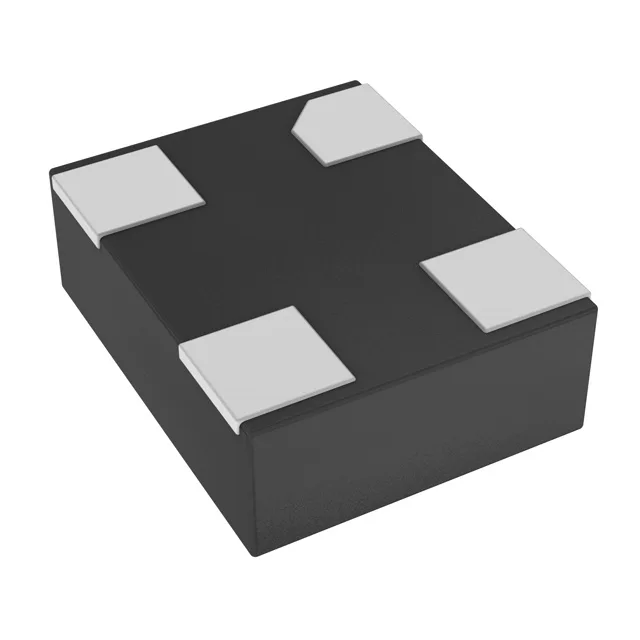
4-SMD no-lead package, 3.20 mm x 2.50 mm, 0.90 mm seated height.