What this MEMS XO replaces: the quartz failure mode
The DSC1001CI2-015.3600 is a MEMS-based XO (Standard) from Microchip's DSC1001 family, delivering a 15.36 MHz CMOS output with ±25 ppm frequency stability — tight enough to clock a CAN transceiver or a 100BASE-TX PHY without a separate PLL. AEC-Q100 qualification (Grade 1, -40°C to +85°C) means this oscillator is production-screened for automotive temperature cycles and mechanical shock — the MEMS resonator inherently survives 50,000 g vibration that would fracture a quartz blank. For an ECU or ADAS module that sees potholes and thermal cycling, that is the difference between a field return and a ten-year service life. Supply voltage spans 1.8 V to 3.3 V with a single rail — no external regulator needed when the core logic runs at 1.8 V and the I/O bank at 3.3 V.
Power budget and standby current
At 15.36 MHz the core draws 6.3 mA max — roughly one-third the current of a comparable quartz oscillator, which matters when the clock tree runs continuously in a battery-backed telematics unit.
Package and footprint for production
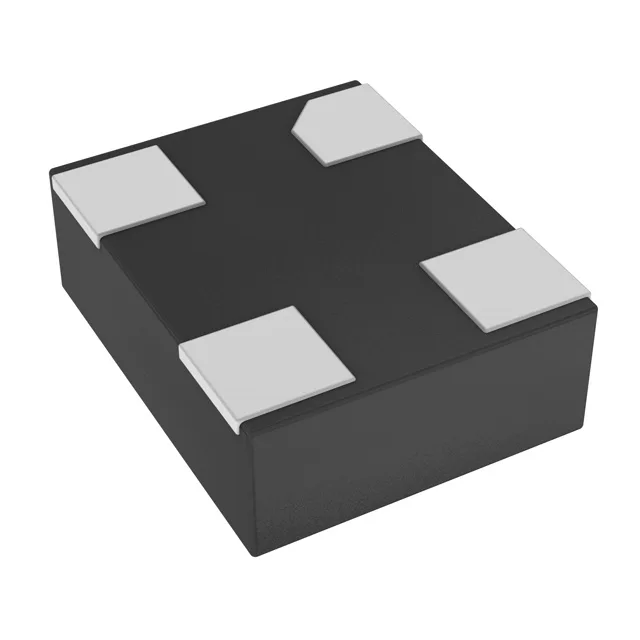
The 4-SMD, no-lead package measures 3.20 mm x 2.50 mm with a seated height of 0.90 mm — compatible with standard 3.2 x 2.5 mm oscillator land patterns. Surface-mount reflow profile follows JEDEC J-STD-020; no special bake required if the moisture-barrier bag is intact.
The DSC1001 series is Microchip's current MEMS oscillator family, so design-in is supported for new programs.