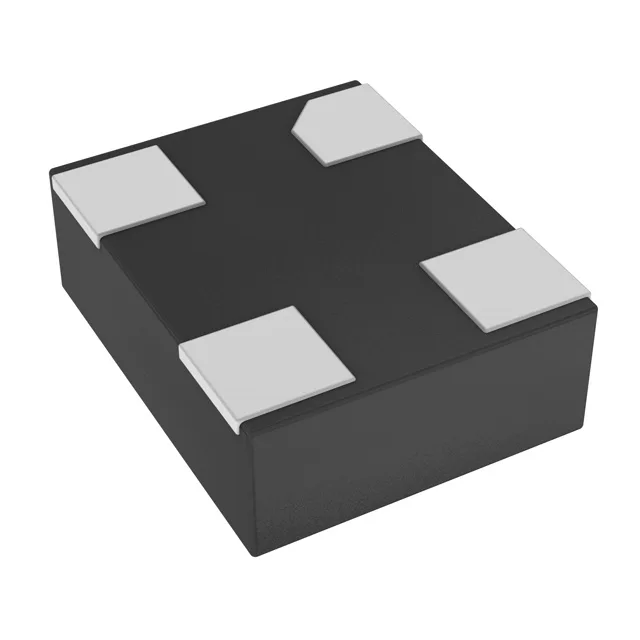
Microchip Technology DSC1001CI1-027.0000T — Crystals & Oscillators

DSC1001CI1-027.0000T 27 MHz MEMS XO AEC-Q100 CMOS Oscillator

MPNDSC1001CI1-027.0000T
Active

Microchip Technology DSC1001CI1-027.0000T — 27 MHz XO (Standard), CMOS output, MEMS resonator, ±50 ppm stability, 1.8 V to 3.3 V supply, AEC-Q100 qualified, standby power-down function, 4-VDFN package.

$1.1100Ref. price · indicative, final on quote
Sourced new & surplus through independent channelsAuthenticity-screened · ESD-safe packingListing updated Aug 2026

Specifications

DSC1001CI1-027.0000T specifications
ParameterValue
TypeXO (Standard)
SeriesDSC1001
MountingSurface Mount
Voltage1.8V ~ 3.3V
Current - supply7.2mA
Current - supply (Disable)15µA
Frequency27 MHz
Frequency stability±50ppm
Operating temperature-40°C~85°C
Size (Dimension)0.126\" L x 0.098\" W (3.20mm x 2.50mm)
Height - seated0.035\" (0.90mm)
OutputCMOS
PackageTape & Reel (TR); Cut Tape (CT)
RatingsAEC-Q100
FunctionStandby (Power Down)
Base resonatorMEMS
Case4-VDFN

Product details

27 MHz automotive-grade MEMS clock source

AEC-Q100 qualification qualifies this part for automotive applications — the MEMS resonator inherently withstands higher shock and vibration than a quartz crystal, making it a fit for engine control units, transmission controllers, and ADAS camera modules where mechanical stress is a concern. The standby (power down) function pulls the disable current to 15 µA max, allowing the system to gate the clock during sleep modes without a separate load switch — useful for battery-backed automotive modules that must meet quiescent current budgets.

Supply voltage flexibility and power budget

The 1.8 V to 3.3 V supply range covers the three most common digital rails — the same oscillator part number can serve a 1.8 V MCU core clock, a 3.3 V peripheral bus, or a 2.5 V FPGA reference without a separate voltage regulator or BOM variant. Maximum supply current is 7.2 mA — for a 27 MHz CMOS output driving a typical 15 pF load, this puts the power dissipation at roughly 24 mW at 3.3 V, well within the thermal budget of the 4-VDFN package without airflow.

Sourced through independent distribution; quoted to order against the BOM quantity.

Frequently asked questions

Can DSC1001CI1-027.0000T replace a quartz oscillator in an automotive design?

Yes, it is a direct functional replacement for a 27 MHz quartz XO with CMOS output. The MEMS resonator offers better shock and vibration tolerance than quartz — this is a genuine advantage in automotive environments. The AEC-Q100 rating confirms it meets automotive reliability requirements. The 4-VDFN package is a standard footprint; verify pad layout compatibility with your existing quartz oscillator's land pattern.

What is the difference between MEMS and quartz oscillators?

MEMS oscillators use a silicon micro-electromechanical resonator instead of a quartz crystal. The MEMS resonator is inherently more resistant to mechanical shock and vibration, has a wider operating temperature range, and typically offers faster start-up time. The trade-off is that close-in phase noise near the carrier can be higher than a good quartz oscillator — though for a 27 MHz CMOS clock feeding a digital ASIC or MCU, the integrated jitter over the relevant band (12 kHz to 20 MHz) is usually within spec.