Why a MEMS oscillator instead of a quartz crystal
The DSC1001CE3-005.0000T uses a MEMS resonator rather than a quartz crystal — inherently more resistant to shock and vibration, with faster startup than a comparable quartz-based XO. For a 5 MHz CMOS clock source in an automotive or industrial environment where the board sees mechanical stress, the MEMS construction avoids the frequency jumps quartz crystals exhibit under high-g vibration.
Automotive-grade qualification and temperature range
AEC-Q100 qualification means this oscillator passed the automotive-grade stress tests — temperature cycling, ESD, latch-up — required for under-hood or chassis-domain ECUs. This limits deployment to cabin or interior automotive modules, not engine bay or transmission environments.
Standby mode for battery-sensitive designs
The standby (power-down) function drops supply current to 15 µA max, compared to 8 mA max during active operation. For a module that spends most of its life asleep and wakes periodically — a tire-pressure sensor or a body-controller node — that 15 µA standby current is low enough to leave the oscillator powered without draining the battery.
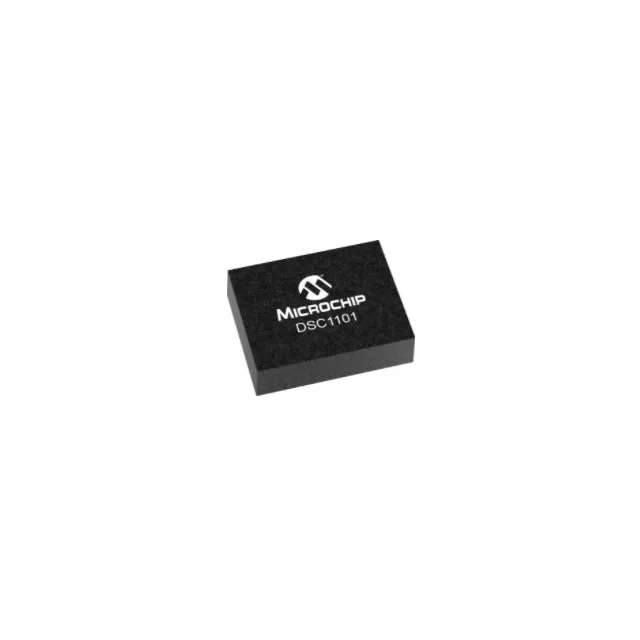
Housed in a 4-VDFN package measuring 3.20 mm x 2.50 mm with a seated height of 0.90 mm. The 0.50 mm pitch (typical for this package class) means the PCB fan-out is straightforward on a two-layer board — no via-in-pad required. The supply voltage range of 1.8V to 3.3V covers common digital rails without an external regulator.