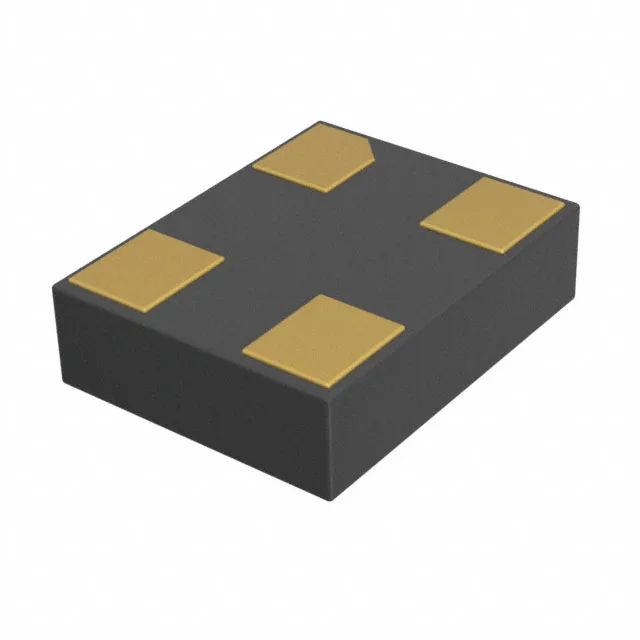
Microchip Technology DSC1001BI3-024.5760T — Crystals & Oscillators

DSC1001BI3-024.5760T MEMS XO 24.576 MHz CMOS AEC-Q100

MPNDSC1001BI3-024.5760T
Active

Microchip DSC1001 series MEMS XO, 24.576 MHz, CMOS output, ±20 ppm stability, AEC-Q100 qualified, 4-VDFN package, tape and reel.

Independent supplier — new & surplus stockAuthenticity-screened · ESD-safe packingListing updated Aug 2026

Specifications

DSC1001BI3-024.5760T specifications
ParameterValue
TypeXO (Standard)
SeriesDSC1001
MountingSurface Mount
Supply voltage1.7V ~ 3.6V
Current - supply8mA
Current - supply (Disable)15µA
Frequency24.576 MHz
Frequency stability±20ppm
Operating temperature-40°C ~ 85°C
Size (Dimension)0.197\" L x 0.126\" W (5.00mm x 3.20mm)
Height - seated0.035\" (0.90mm)
OutputCMOS
PackageTape & Reel (TR)
RatingsAEC-Q100
FunctionStandby (Power Down)
Base resonatorMEMS
Case4-VDFN

Product details

MEMS resonator replaces quartz in a 4-VDFN footprint

The DSC1001BI3-024.5760T is a MEMS-based XO (Standard) that outputs a 24.576 MHz CMOS clock from a 4-VDFN package measuring 5.00 mm x 3.20 mm — a drop-in alternative to quartz oscillators in the same footprint. A MEMS resonator is less susceptible to vibration and shock than a quartz crystal, which matters for automotive and industrial environments where mechanical stress is routine.

Automotive-grade timing with wide supply flexibility

Max supply current is 8 mA during operation; the standby (power-down) function drops draw to 15 µA max, useful for battery-backed real-time clocks or wake-up circuits.

Listed as Active by Microchip, the DSC1001BI3-024.5760T is a current production part suitable for new designs and ongoing BOMs.

Frequently asked questions

Can DSC1001BI3-024.5760T replace a standard quartz oscillator?

Yes, in most cases. The 4-VDFN package matches common quartz oscillator footprints (5.0 x 3.2 mm), and the CMOS output is directly compatible. The MEMS resonator offers better shock and vibration tolerance, but check your system's jitter budget — MEMS oscillators have a different phase-noise profile than quartz. The ±20 ppm stability is equivalent to a standard quartz XO.