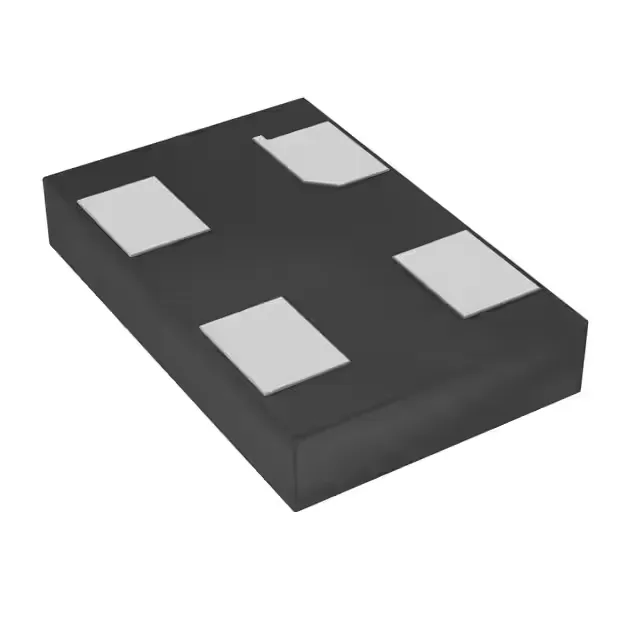
Microchip Technology DSC1001BI1-024.5760 — Crystals & Oscillators

DSC1001BI1-024.5760 MEMS XO – 24.576 MHz, CMOS, AEC-Q100

MPNDSC1001BI1-024.5760
Active

Microchip Technology DSC1001BI1-024.5760, MEMS-based XO (Standard), 24.576 MHz, CMOS output, ±50 ppm stability, 1.8V–3.3V supply, AEC-Q100 qualified, -40°C to 85°C, 4-SMD no-lead package.

$0.9450Ref. price · indicative, final on quote
Independent supplier — new & surplus stockAuthenticity-screened · ESD-safe packingListing updated Aug 2026

Specifications

DSC1001BI1-024.5760 specifications
ParameterValue
TypeXO (Standard)
SeriesDSC1001
MountingSurface Mount
Supply voltage1.8V ~ 3.3V
Current - supply6.3mA
Current - supply (Disable)15µA
Frequency24.576 MHz
Frequency stability±50ppm
Operating temperature-40°C~85°C
Size (Dimension)0.197\" L x 0.126\" W (5.00mm x 3.20mm)
Height - seated0.035\" (0.90mm)
OutputCMOS
PackageTube
RatingsAEC-Q100
FunctionStandby (Power Down)
Base resonatorMEMS
Case4-SMD, No Lead

Product details

The supply voltage range of 1.8V to 3.3V lets it run directly from a 1.8V core rail or a 3.3V I/O bank without a level shifter, simplifying the power tree.

Housed in a 4-SMD, No Lead package measuring 5.00 mm x 3.20 mm with a seated height of 0.90 mm — the standard 5.0 x 3.2 mm footprint that matches many quartz oscillators, so a layout designed for a quartz XO can often take this MEMS part without a board spin. Surface-mount mounting with no exposed pad simplifies reflow; the MEMS die is encapsulated, so no special handling beyond standard MSL precautions.

Listed as Active — Microchip continues to manufacture and support the DSC1001 series.

Frequently asked questions

Is the DSC1001BI1-024.5760 AEC-Q100 qualified?

Yes, it carries AEC-Q100 ratings. This covers the automotive-grade qualification for temperature, reliability, and ESD per the AEC-Q100 stress test sequence.

What is the frequency stability of the DSC1001BI1-024.5760?

This is tighter than the ±100 ppm typical of basic oscillators and sufficient for most USB, Ethernet, and audio clock applications.

What is the difference between the DSC1001 and DSC1121 series?

The DSC1121 series offers lower jitter and a wider frequency range, but the DSC1001 is the cost-optimized automotive-grade family. For a 24.576 MHz clock with AEC-Q100, the DSC1001 is the correct choice unless the application requires sub-1 ps RMS phase jitter.