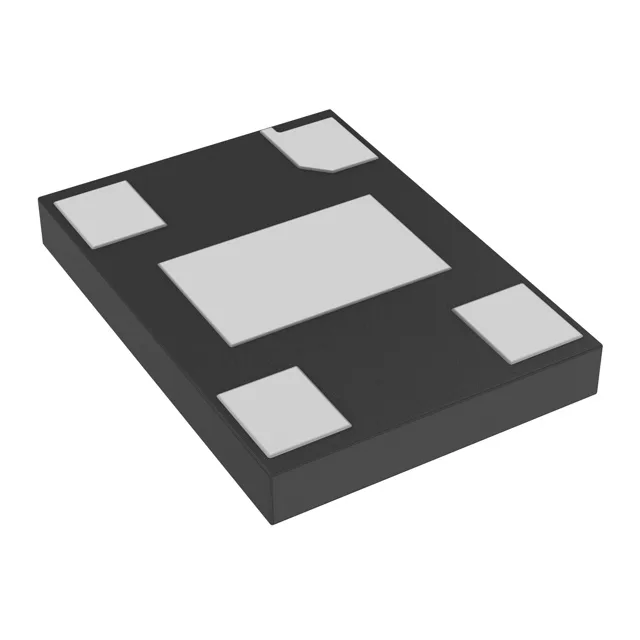
Microchip Technology DSC1001AI5-024.5760T — Crystals & Oscillators

DSC1001AI5-024.5760T MEMS Oscillator – 24.576 MHz, AEC-Q100

MPNDSC1001AI5-024.5760T
Active

Microchip DSC1001AI5-024.5760T, 24.576 MHz MEMS XO, CMOS output, ±10 ppm stability, AEC-Q100, -40°C to +85°C, 1.8V–3.3V supply, 4-SMD no-lead exposed pad package.

$2.1750Ref. price · indicative, final on quote
Sourced new & surplus through independent channelsAuthenticity-screened · ESD-safe packingListing updated Aug 2026

Specifications

DSC1001AI5-024.5760T specifications
ParameterValue
TypeXO (Standard)
SeriesDSC1001
MountingSurface Mount
Voltage1.8V ~ 3.3V
Current - supply6.3mA
Current - supply (Disable)15µA
Frequency24.576 MHz
Frequency stability±10ppm
Operating temperature-40°C~85°C
Size (Dimension)0.276\" L x 0.197\" W (7.00mm x 5.00mm)
Height - seated0.035\" (0.90mm)
OutputCMOS
PackageTape & Reel (TR)
RatingsAEC-Q100
FunctionStandby (Power Down)
Base resonatorMEMS
Case4-SMD, No Lead Exposed Pad

Product details

Supply range and standby power-down

A single supply rail from 1.8V to 3.3V covers 1.8V, 2.5V, and 3.3V logic families without a separate regulator — simplifies the BOM for mixed-voltage designs where the oscillator sits on a shared rail with the MCU or FPGA bank.

The 4-SMD, No Lead Exposed Pad package measures 7.00 mm x 5.00 mm with a seated height of 0.90 mm max — a standard 7x5 mm ceramic oscillator footprint that matches many quartz XO land patterns, simplifying a drop-in replacement.

Frequently asked questions

How does the DSC1001AI5-024.5760T compare to a quartz oscillator at the same frequency?

The MEMS resonator eliminates the need for external load capacitors and has faster startup than a quartz crystal oscillator — typically under 2 ms vs 10–20 ms for a quartz-based XO. The ±10 ppm stability is comparable to a standard quartz XO, but the MEMS part holds frequency better under vibration and has no activity dips. The trade-off is that the MEMS oscillator's phase noise floor is slightly higher than a high-end quartz OCXO, but for 24.576 MHz CMOS clocking into an MCU or FPGA, the difference is negligible.

What is the standby pin function on the DSC1001AI5-024.5760T?

The Standby (Power Down) function disables the output when the pin is pulled low (or high, depending on the variant — check the DSC1001 family datasheet for the logic polarity). In standby, the supply current drops to 15 µA max, and the output enters a high-impedance state. The MEMS resonator remains biased, so wake-up is faster than a full power cycle.