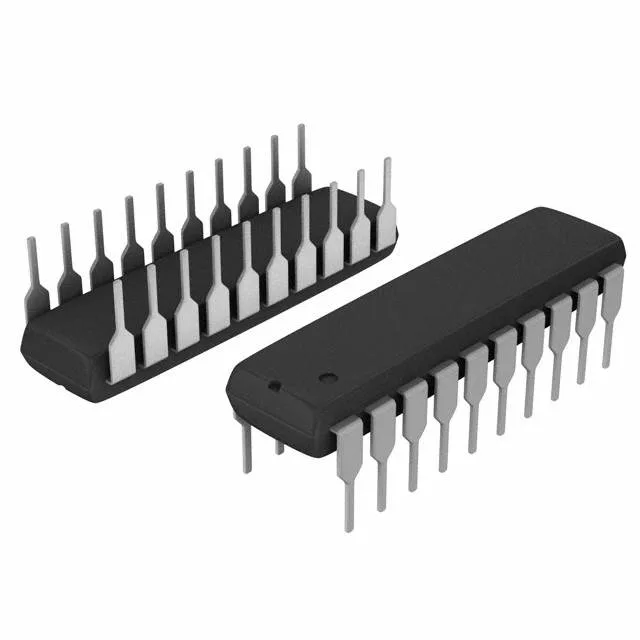
The Microchip ATTINY2313-20PU is an 8-bit AVR microcontroller from the ATtiny family, built around the AVR core with a 20 MHz maximum clock speed. It packs 2 KB of Flash program memory, 128 bytes of SRAM, and 128 bytes of EEPROM — enough for small control tasks like reading a few sensors, driving a PWM output, or managing a simple UART or SPI link. The 18 general-purpose I/O lines give you room for a handful of buttons, LEDs, and a serial interface without needing external expanders. The 20-pin DIP package (0.300" width) is a through-hole part — breadboard-friendly, easy to hand-solder, and compatible with legacy sockets.
At 20 MHz, the ATTINY2313-20PU executes most AVR instructions in a single clock cycle, giving roughly 20 MIPS throughput. That is enough for UART baud rates up to 1.25 Mbps (assuming the internal oscillator is trimmed), PWM frequencies in the tens of kilohertz with reasonable resolution, and polling or interrupt-driven I/O at microsecond-level response. It is not a part for heavy DSP or complex protocol stacks — the 2 KB Flash fills fast with anything beyond a few hundred lines of C. For timing-critical UART communication or precise PWM, an external clock source can be fed in through the XTAL pins.
Memory footprint: 2 KB Flash, 128 B SRAM, 128 B EEPROM
The 2 KB Flash is the hard limit for your compiled code — think small state machines, sensor polling loops, or a bootloader that occupies the first 512 bytes. The 128 bytes of SRAM is the runtime scratchpad: a few global variables, a small stack, and maybe a 16-byte UART buffer. The 128 bytes of EEPROM is non-volatile storage for calibration constants, configuration bytes, or a device serial number — endurance is typically 100k write cycles per byte. If your application needs more than a few hundred bytes of SRAM or code beyond 2 KB, this part will not fit — look at the ATtiny24/44/84 or ATmega48/88/168 families for a pin-compatible step up in memory.
The SPI and UART/USART interfaces let it talk to sensors, displays, or a host microcontroller without bit-banging.
ROHS3 compliant. That means no last-time-buy scramble, no forced redesign for obsolescence. There is no official second-source alternate from another manufacturer, but the pin-compatible ATtiny2313A and ATtiny2313V variants (same 20-DIP footprint) offer lower voltage or speed options if the supply chain needs flexibility.