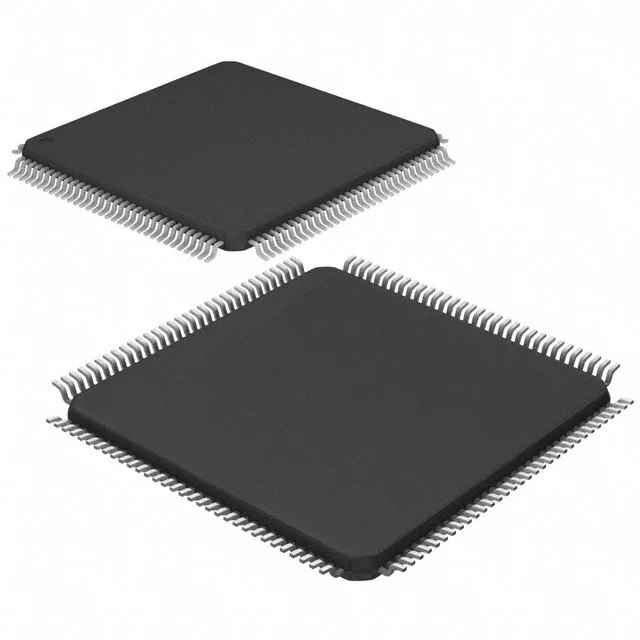
ARM Cortex-M4F at 120 MHz — what the core clock buys you
The ATSAMD51P19A-AU: That core clock and FPU mean this part handles real-time control loops, sensor fusion, and audio DSP without an external co-processor — the M4F pipeline executes a multiply-accumulate in a single cycle, which matters when you're closing a servo loop or running an FFT on ADC data.
With 512 KB of program Flash and 192 KB of SRAM, this MCU fits a mid-complexity firmware image — a FreeRTOS or ThreadX kernel with TCP/IP stack, USB device stack, and a modest application layer — without needing external memory. The 192 KB RAM covers double-buffered frame buffers for a small TFT display or a circular buffer for audio streaming.
99 I/O in a 128-TQFP — layout and routing considerations
The 128-TQFP package (14x14 mm body, 0.4 mm pitch) exposes 99 general-purpose I/O pins. That's enough to drive a parallel TFT display (RGB-565, 16-bit), interface to an external SRAM or NOR Flash via the EBI/EMI controller, and still have pins left for UART, I2C, SPI, and GPIO for buttons and LEDs.
The wide Vdd range from 1.71V to 3.63V means this MCU can run directly from a single-cell Li-Po battery (3.0V to 4.2V with a regulator) or from a 3.3V rail without an additional LDO for the core. At the low end, 1.71V is below the typical 1.8V threshold — the internal POR and BOD circuits handle the brown-out detection, so you can safely operate near the battery's discharge cutoff. At 3.63V max, a 3.6V rail from a boost converter is within spec, but a 5V USB rail needs a regulator.
It covers outdoor telecom cabinets, factory floor controllers, HVAC systems, and automotive cabin electronics. It does not cover under-hood or engine-bay environments.
The SAM D51 series is a mainstream portfolio — Microchip continues to invest in the M4F Cortex line alongside the newer PIC32MZ families. There is no LTB window to track.
Analog front-end: 32-channel ADC and dual DAC
The integrated 12-bit ADC with 32 multiplexed channels and two 12-bit DACs covers multi-sensor acquisition without external analog components. The 32 channels handle up to 32 single-ended analog inputs.