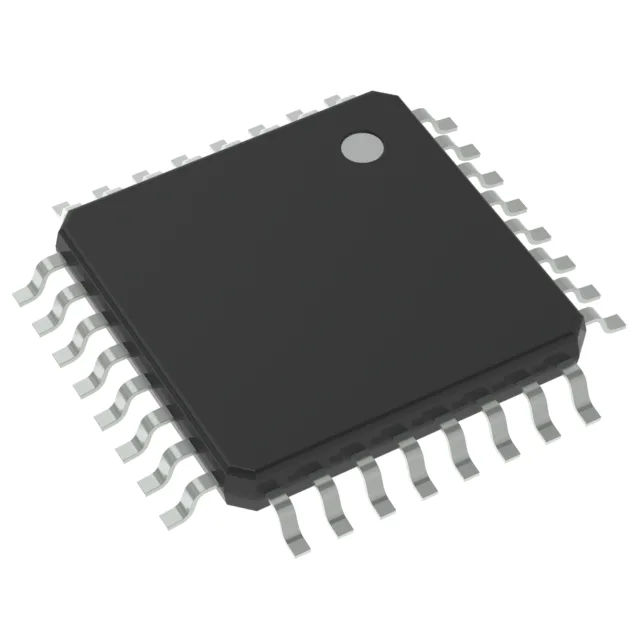
Automotive-grade Cortex-M0+ for LIN and sensor nodes
The 32-TQFP package gives you 26 I/O, with connectivity covering I²C, LINbus, SPI, and UART/USART — a natural fit for LIN slave nodes, body-control modules, or sensor aggregation in under-hood and cabin environments.
48 MHz clock and 32 KB Flash — sizing the firmware budget
At 48 MHz the Cortex-M0+ delivers single-cycle multiply and a 2-stage pipeline, enough for real-time LIN message handling or 12-bit ADC sampling at moderate rates. The 32 KB Flash is on the smaller side for the SAM D21 family — plan for a lean firmware image if you are adding a bootloader and a communication stack. The 4 KB SRAM (4K x 8) limits runtime data buffers; a complex state machine or audio processing will push against that ceiling.
This part carries AEC-Q100 qualification and is listed under the Functional Safety (FuSa) series, which means it has been through the stress tests (HTOL, HBM, latch-up) required for automotive Tier-1 production. The 1.62 V minimum supply allows operation during cold-crank events down to near 1.6 V, which is critical for automotive modules that must stay alive through a voltage sag.
The base product number is ATSAMD21, so any future PCN or EOL will be issued against that base; keep an eye on Microchip's PCN feed for the SAM D21 family.
Peripherals and I/O — what is on the 32-TQFP
The 32-TQFP (7x7 mm) exposes 26 I/O. On-chip peripherals include a 10-channel 12-bit ADC, a single 10-bit DAC, internal oscillator, brown-out detect, POR, PWM, WDT, DMA, and an I²S interface. The connectivity set — I²C, LINbus, SPI, UART/USART — covers the common automotive serial buses. LIN is the natural fit here.