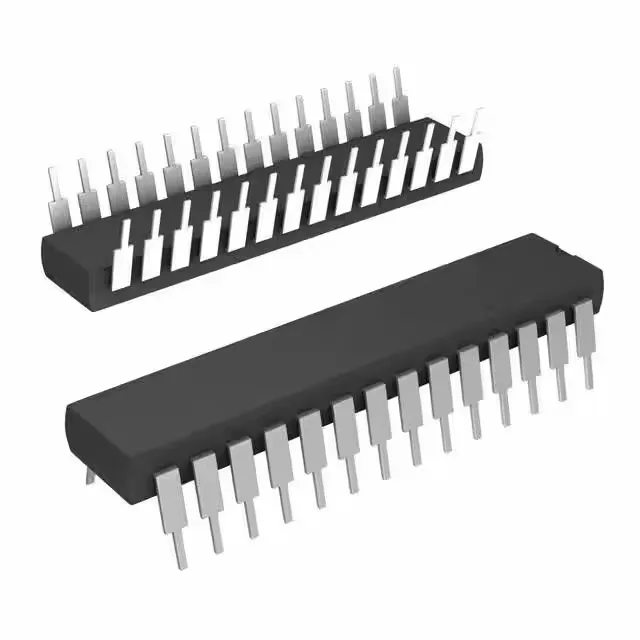
This 28-pin DIP AVR — what it brings to a through-hole BOM
The Microchip ATMEGA48P-20PU is an 8-bit AVR microcontroller in a 28-pin PDIP package, running at 20 MHz with 4 KB of flash program memory. It carries 512 bytes of SRAM and 256 bytes of EEPROM, along with 23 general-purpose I/O lines.
20 MHz throughput — what the 1 MIPS per MHz means for loop timing
At 20 MHz this core executes most instructions in a single clock cycle, delivering roughly 20 MIPS. That is enough for a 10 kHz control loop with headroom for protocol handling and ADC reads.
4 KB flash and 512 bytes SRAM — sizing the firmware budget
The 4 KB flash (2K x 16) is the hard ceiling for compiled code. With 512 bytes of SRAM, look-at tables and interrupt contexts must be kept small. The 256 bytes of EEPROM can hold calibration constants or configuration bytes that survive power loss. If the application needs more than a few kilobytes of code or a moderate RAM buffer, stepping to the ATMEGA48's higher-density siblings in the same DIP footprint is the practical move.
Active lifecycle — no LTB concern for current builds
The base product number ATMEGA48 gives a clear path to pin-compatible upgrades (e.g., more flash) within the same AVR family if project requirements grow.
Through-hole PDIP — designed for hand-assembly and socketed prototyping
The 28-pin PDIP (0.300" row spacing) is a traditional through-hole package. It fits standard 0.1" protoboards, DIP sockets, and wave-solder lines. The wide pin pitch simplifies rework and makes this a go-to for one-off builds, educational kits, and legacy product maintenance where an SMT adapter would add cost.