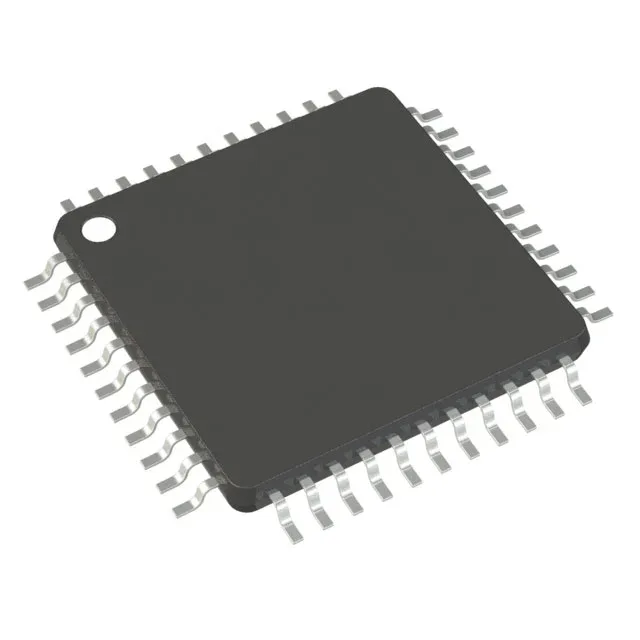
8-bit AVR with native USB — the Arduino Micro engine
Its standout feature is an integrated USB 2.0 full-speed controller — no external USB-to-serial bridge needed — which is why it powers the Arduino Micro and Leonardo boards.
USB without the glue logic
The on-chip USB 2.0 full-speed peripheral (12 Mbps) is the key differentiator versus most 8-bit MCUs in this price tier. It handles the USB D+ and D- lines directly, with internal pull-up resistors and a dedicated 48 MHz PLL derived from the 16 MHz main clock.
For a design that relies on the native USB peripheral, this part has been a stable, long-running choice with no forced migration on the horizon.
Memory budget and internal oscillator
The 1 KB EEPROM is useful for calibration constants or configuration data that survive a firmware update. An internal oscillator is included, so a crystal is optional for many applications — though the USB peripheral requires the 16 MHz clock source to be accurate within ±0.25% for full-speed operation, which typically means using the internal PLL with the external crystal or resonator.