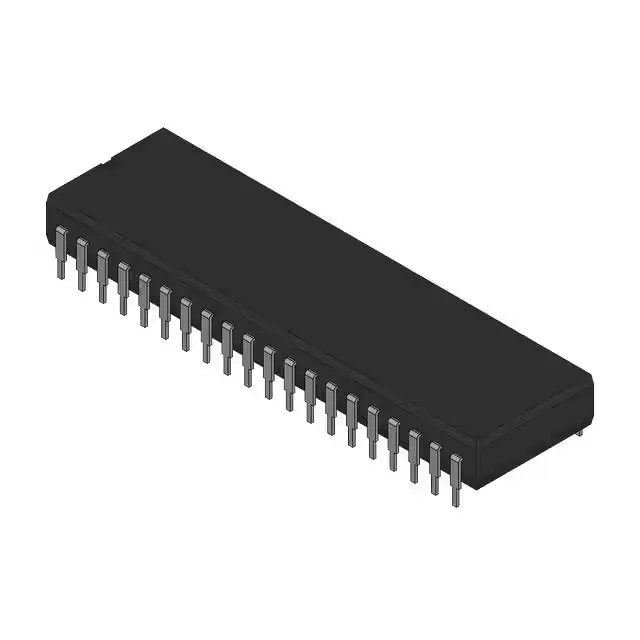
The Microchip ATMEGA324PV-10PU is an 8-bit AVR microcontroller in a 40-pin DIP package — the through-hole version of the ATmega324P family, running at 10 MHz.
At 10 MHz the AVR core executes most instructions in a single clock cycle, so a tight sensor-read–PID–PWM-update loop runs around 5–10 MIPS. That is enough for 1 kHz current loops, UART polling at 115.2 kbaud, or driving a character LCD — but not for software bit-banging of high-speed protocols or real-time audio. The internal oscillator is on-chip, so no external crystal is needed for many applications, though the peripheral set includes an external oscillator option if accuracy matters.
Memory sizing for the firmware image
32 KB of Flash is comfortable for a bootloader plus a moderate application (e.g., Modbus RTU slave, sensor fusion with logging). The 2 KB SRAM is the real constraint — it limits buffering for complex protocol stacks or large lookup tables. The 1 KB EEPROM is useful for calibration constants and configuration that survive a firmware update. If the application needs more RAM, stepping to the ATmega324PB or ATmega644 family (4 KB SRAM) is the usual move.
Through-hole DIP — prototyping ease vs. production density
The 40-pin DIP (0.600-inch width, 15.24 mm row spacing) is a breadboard-friendly footprint that makes hand assembly and rework trivial. For low-volume or development builds this is an advantage — no stencil, no reflow profile. For high-volume production, the same MCU is available in surface-mount packages (TQFP-44, QFN-44) that save board area and support automated assembly. The through-hole version also mates with standard IC sockets, which speeds field replacement.