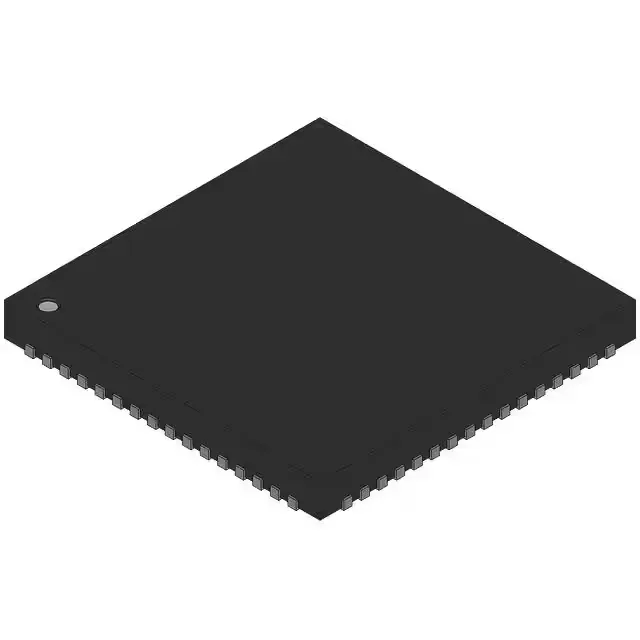
What this 8-bit AVR does — and what it costs to ignore the LCD controller
The Microchip ATMEGA169P-16MCU is an 8-bit AVR microcontroller with a 16 MHz core, 16 KB of Flash program memory, 1 KB of SRAM, and 512 bytes of EEPROM. Its standout peripheral is an integrated LCD controller, which drives segment displays directly without an external driver chip — a feature that saves board space and BOM cost in metering, instrumentation, and panel-display applications.
16 MHz, 16 KB Flash — sizing the memory and speed for the job
The 16 MHz core speed is typical for an 8-bit AVR at this tier — enough for real-time control loops, serial protocol handling, and display updates without a crystal (internal oscillator is on-chip). The 16 KB Flash is organized as 8K x 16 words, which constrains firmware size: a moderate application with a segmented LCD driver, a few ADC channels, and UART communication fits comfortably, but complex GUI libraries or over-the-air update staging will push the limit. The 1 KB SRAM handles a handful of buffers and stack frames; the 512-byte EEPROM is useful for calibration constants or configuration that must survive a power cycle. If your firmware already targets the ATmega169P, the memory map is fixed — there is no larger Flash variant in this exact die, so a code-size overflow means a port to a higher-density AVR family.
Package and thermal: 64-QFN with exposed pad
Microchip no longer manufactures this device in volume, and no last-time-buy window is indicated in the available records. For existing BOM lines, the only sourcing channel is the independent distribution market, where inventory is finite and pricing reflects scarcity. There is no official Microchip successor order code listed for this specific package variant, so any replacement will require a pin-compatible or functionally equivalent cross.