The Microchip ATMEGA1608-AFR is an 8-bit AVR microcontroller from the megaAVR® 0 series, which carries a Functional Safety (FuSa) designation.
Package and footprint — 32-TQFP (7x7 mm)
32-lead TQFP package measuring 7x7 mm with 27 I/O pins.
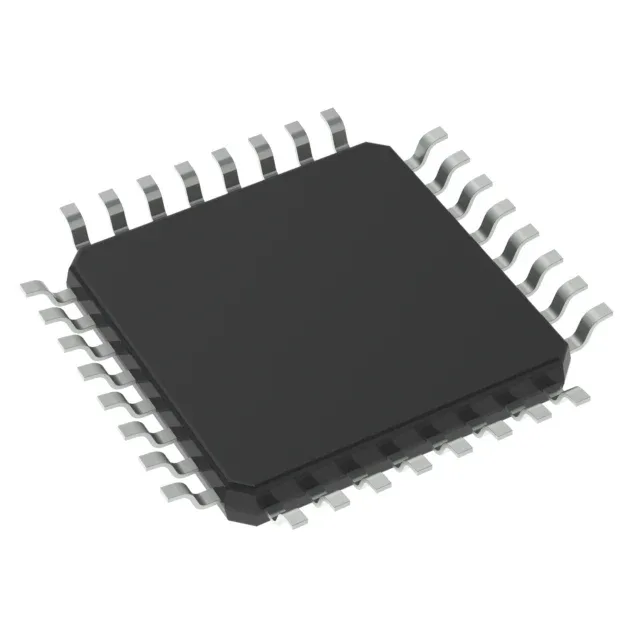
Microchip megaAVR® 0, Functional Safety (FuSa) series, ATMEGA1608-AFR, 8-bit AVR MCU, 20 MHz, 16KB Flash, 2K x 8 SRAM, 256 x 8 EEPROM, 1.8V~5.5V, -40°C~125°C, 32-TQFP.
| Parameter | Value |
|---|---|
| Series | megaAVR® 0, Functional Safety (FuSa) |
| Mounting | Surface Mount |
| Oscillator type | Internal |
| Program memory type | FLASH |
| Voltage - supply (Vcc (Vdd)) | 1.8V ~ 5.5V |
| Operating temperature | -40°C~125°C |
| Speed | 20MHz |
| Package | Tape & Reel (TR); Cut Tape (CT) |
| RAM size | 2K x 8 |
| Core size | 8-Bit |
| EEPROM size | 256 x 8 |
| Peripherals | Brown-out Detect/Reset, POR, WDT |
| Connectivity | I²C, SPI, UART/USART |
| Number of i (O) | 27 |
| Core processor | AVR |
| Case | 32-TQFP |
| Data converters | A/D 12x10b |
| Program memory size | 16KB (16K x 8) |
The Microchip ATMEGA1608-AFR is an 8-bit AVR microcontroller from the megaAVR® 0 series, which carries a Functional Safety (FuSa) designation.
32-lead TQFP package measuring 7x7 mm with 27 I/O pins.
The ATMEGA1608-AFR and ATMEGA1608-AF share the same base product number (ATMEGA1608) and the same 32-TQFP package. The -AFR suffix indicates Tape & Reel packaging; the -AF suffix typically indicates a different reel or tray quantity. Electrically they are identical — the difference is only in the shipping medium. Verify the packaging requirement for your assembly line before substituting.
The ATMEGA3208-AFR is a higher-density sibling in the same megaAVR 0 family. The ATMEGA1608-AFR has 16 KB Flash, 2 KB SRAM, and 256 B EEPROM; the ATMEGA3208-AFR doubles the Flash to 32 KB and the SRAM to 4 KB, with the same EEPROM size. Choose the 3208 if your firmware exceeds 16 KB or you need more RAM for data buffers.
The ATMEGA1608-AFR is programmed via the AVR UPDI (Unified Program and Debug Interface) using a single-wire connection. Microchip tools like the MPLAB Snap, PICkit 4, or Atmel-ICE support UPDI. The internal oscillator is enabled by default, so no external clock is needed for programming. The part can also be programmed in-system via the UPDI pin.
Yes. All I/O pins are 5 V tolerant when the device is powered within that range. This simplifies interfacing with 5 V logic peripherals without level shifters.