Obsolete — plan the replacement now
This means Microchip has ended production, and no further factory orders are accepted. For a BOM line that still needs this part, the only channel is independent distribution — sourced against an RFQ from surplus or remaining distributor stock.
15 ns speed — what it buys on the bus
The 15 ns propagation delay (tpd) is the time from input through the AND-OR array to the registered or combinatorial output. In a 5V system, this supports clock rates up to about 50-60 MHz for registered state machines, and keeps combinatorial path delays under one 74LS TTL gate-equivalent. For a legacy 5V backplane or address decoder, 15 ns is fast enough to avoid wait states with most 16- and 32-bit processors of the era.
10 macrocells — logic capacity check
Ten macrocells, each configurable as registered or combinatorial, give roughly 200-300 gate-equivalent logic. This fits small state machines, address decoders, bus arbiters, or PAL/GAL replacement. If your design needs more than 10 registered outputs or a wider product-term array, you are looking at a larger 22V10 variant or a CPLD like the ATF150x family.
28-PLCC J-Lead — footprint and rework
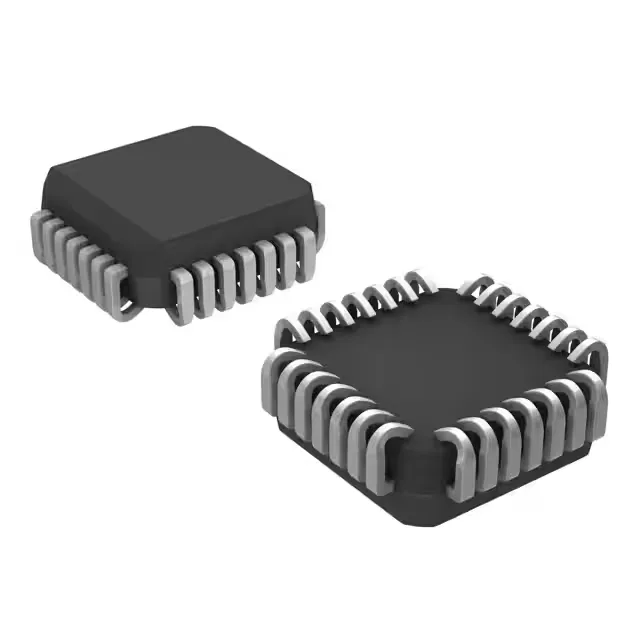
The 28-PLCC (J-Lead) package, 11.51 x 11.51 mm body, is a surface-mount legacy footprint. J-Leads are less prone to tombstoning than gull-wing, but the package body hides the solder joints — inspection requires an X-ray or a PLCC socket. For rework, a hot-air nozzle with a PLCC profile works; the J-Lead wicks solder from the pad if the stencil aperture is not matched.
5V-only supply — level translation needed for mixed-voltage boards
This part operates on a 5V supply rail only. Input and output levels are 5V CMOS/TTL compatible. The 5V rail also means the PLD draws its full Icc from the 5V supply — factor that into the regulator budget.