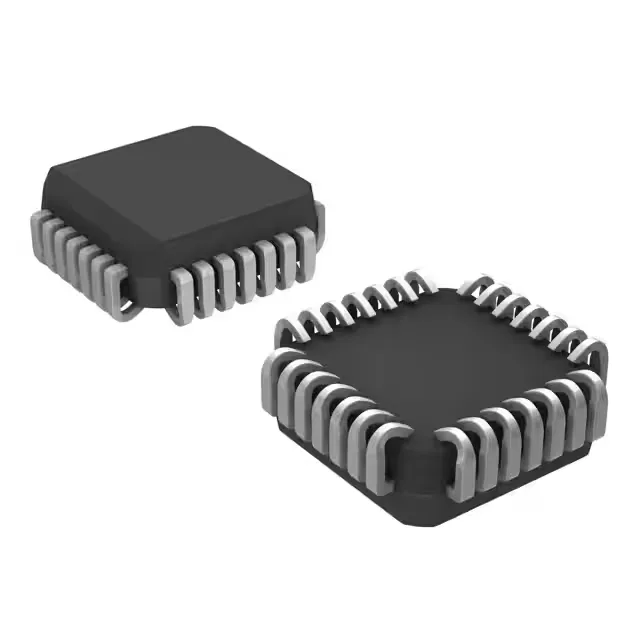
The Microchip ATF22V10CZ-12JC is an electrically-erasable programmable logic device (EE PLD) from the industry-standard 22V10 series. It integrates 10 macrocells, each configurable as registered or combinatorial output, with a propagation delay of 12 ns — fast enough to decode addresses or sequence state machines in 5V systems running at up to about 50 MHz. The 5V-only supply and 28-PLCC (J-Lead) package target legacy 5V backplanes, industrial controllers, and telecom line cards where the rest of the board still runs on a 5V rail.
12 ns speed — timing budget for a 5V bus
The 12 ns propagation delay (tPD) is the time from input through the AND-OR array to the registered or combinatorial output. In a typical address-decode application, that 12 ns must fit within the memory or peripheral's setup-time window before the next clock edge. At a 50 MHz system clock (20 ns period), the 12 ns tPD leaves 8 ns for the output to settle and the receiving device to meet its setup — tight but workable with fast SRAM or FIFO. Slower peripherals with longer setup times may force a lower clock rate or a faster PLD variant.
10 macrocells — logic capacity for a handful of equations
Ten macrocells give enough registered or combinatorial logic to replace a few 7400-series SSI/MSI parts — think address decoders, simple state machines, bus-arbitration logic, or interface glue between a microcontroller and an FPGA. Each macrocell includes a programmable flip-flop (D/T/JK) and an output polarity control. For designs that need more than ten registered outputs or more complex combinatorial terms, the 22V10 family scales up to the ATF22V10C (same pinout, same 24-pin footprint) with 10 macrocells as well; the difference is in the speed grade and the 'Z' variant's power-saving feature.
28-PLCC — footprint and rework considerations
The 28-PLCC (J-Lead) package measures 11.51 x 11.51 mm with leads bent under the body. It is a surface-mount package but requires a dedicated PLCC socket or a hot-air rework station with a J-Lead nozzle — standard QFP tweezers will not grip the leads. The J-Lead footprint is less common on modern boards; if the existing PCB uses a PLCC-28 land pattern, this part drops in. If not, the 28-PLCC adds a socket cost and a taller profile than a TQFP.
5V-only supply — compatibility check
The ATF22V10CZ-12JC operates on a single 5V supply with 5V-tolerant inputs and outputs. It is not 3.3V-compatible on either side — mixing with a 3.3V logic family requires level translators or a separate 5V rail. In a mixed-voltage design, the 5V output swing can overstress a 3.3V input; a series resistor or a voltage divider is needed. For a pure 5V system, this part is a direct fit.
The 'CZ' suffix indicates a power-saving variant (CMOS Z) that may have been a niche option. For new designs, the standard ATF22V10C-12JC (same speed, same package, same 10 macrocells) is the closest functional equivalent — it shares the same 22V10 architecture and 28-PLCC footprint, though the 'CZ' variant's lower power consumption is not replicated. The ATF22V10C-12JC is also obsolete, so both parts are sourced through independent distribution on a last-time-buy or surplus basis.