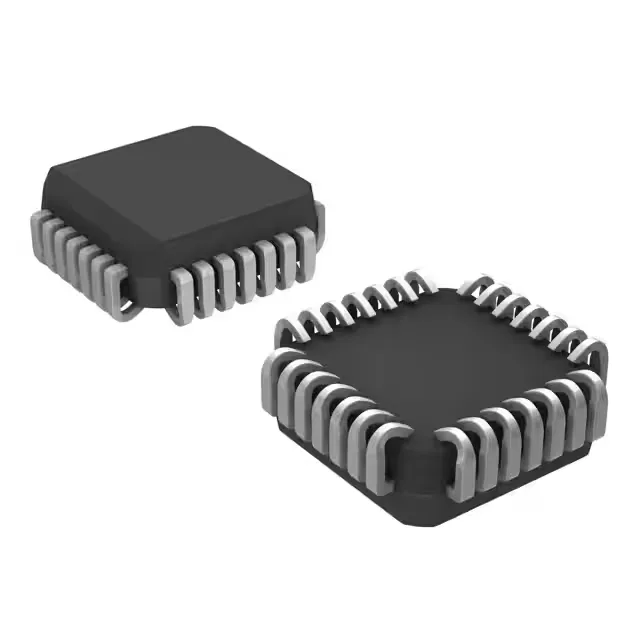
The ATF22V10CQZ-20JU is a 5 V electrically-erasable programmable logic device from Microchip's 22V10 family, built on the industry-standard 22V10 architecture. Ten macrocells, each configurable as registered or combinatorial, give you the equivalent of ten 16V8 PALs in one package. The 20 ns propagation delay applies to both combinatorial (tPD) and registered (tCO) paths — at that speed you can clock registered logic up to about 50 MHz with reasonable timing margin, or use the combinatorial path for fast address decoding, state-machine next-state logic, or bus-interface glue without adding wait states.
5 V-only I/O — no level translation needed in legacy 5 V systems
This part operates from a single 5 V supply and its I/O pins are 5 V-tolerant TTL/CMOS compatible. If your board already runs on 5 V — common in industrial control, motor-drive interface, and older telecom line cards — you can drop this PLD straight onto the bus without a voltage regulator or level shifter.
10 macrocells — understand the logic ceiling
Each macrocell contains one flip-flop (D-type, configurable as T or JK) and one sum-of-product term. The 10-macrocell count is the absolute limit on registered outputs; if your state machine needs 11 states or your decoder needs 11 product-term outputs, this part will not fit. For designs that fit within 10 macrocells and 20 ns, the 22V10 architecture is well-understood and supported by legacy tools (CUPL, ABEL, WinCUPL).
28-PLCC J-lead package — footprint and rework considerations
The 28-lead PLCC (JEDEC MO-047, 11.51 x 11.51 mm body) uses J-shaped leads that wrap under the package body. This footprint requires a solder-paste stencil with apertures sized for the J-lead geometry — typically 0.66 x 1.27 mm per pad. Rework with hot air is straightforward because the J-leads are accessible from the side, but the package is more susceptible to solder-joint cracking under board flex than a gull-wing QFP. A conformal coat or mechanical support is advisable in high-vibration environments.
No PCN or EOL notice has been issued. The 22V10 architecture remains a staple for low-density glue logic, and Microchip continues to manufacture the ATF22V10C family in volume.