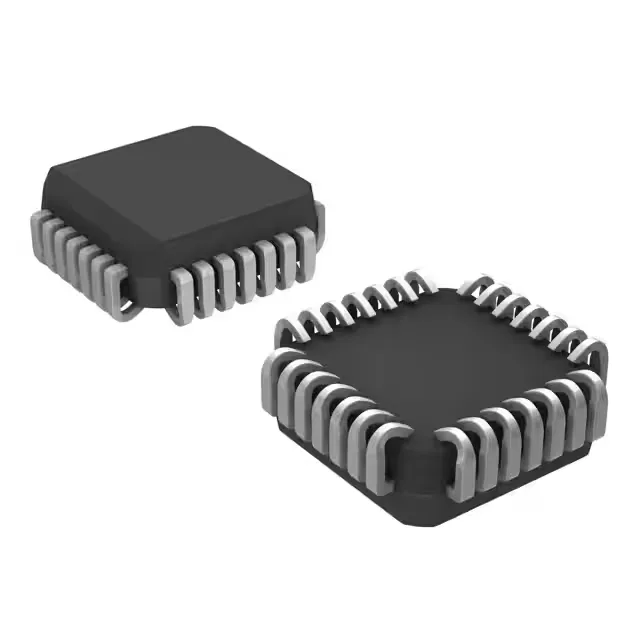
15 ns EE PLD — 22V10 architecture in 28-PLCC
The Microchip ATF22V10CQ-15JU is an electrically-erasable programmable logic device (EE PLD) from the industry-standard 22V10 family, offering 10 macrocells with a 15 ns propagation delay. It operates from a single 5V supply and is housed in a 28-lead PLCC with J-leads (11.51x11.51 mm body). This is the part for legacy 5V glue logic, address decoding, bus arbitration, and small state machines where the 22V10 architecture and PLCC footprint are already on the board.
The 15 ns propagation delay (tPD) sets the combinatorial input-to-output path. For a 5V system running a 33 MHz bus (30 ns cycle), this part leaves 15 ns of timing margin after the clock edge for address decode and chip-select generation — enough for a single level of logic without pipeline registers. If your system clock is faster or the decode path has multiple PLD stages, the margin shrinks; verify the worst-case combinatorial path against your setup/hold requirements.
10 macrocells — density for the job
Ten macrocells, each configurable as registered or combinatorial output with programmable polarity. That is the standard 22V10 count — enough for an 8-bit address decoder plus two chip-selects, or a 4-state machine with registered outputs. For designs that outgrow this, the 22V10 family scales to 15 ns in the same PLCC footprint; no board respin needed.
5V supply — legacy rail, no level translation
Single 5V supply. No core/IO split — the entire device runs on the same 5V rail as TTL and HC logic families. In a mixed-voltage board (3.3V MCU, 5V peripheral), the PLD outputs drive 5V logic directly but need level shifters or open-drain buffers to talk to the 3.3V side. The 5V-only supply is a fit signal for existing 5V backplanes and industrial I/O cards.
28-PLCC J-Lead — footprint and rework
The 28-lead PLCC (J-Lead) package measures 11.51x11.51 mm. J-leads allow visual inspection of solder joints and easier hand-rework than QFP or BGA. The footprint is socket-compatible with standard 28-pin PLCC sockets for prototyping or field upgrades. The J-lead form also provides some compliance to board flex — a consideration for high-vibration environments.
For BOM sustainment, this part is available through standard distribution and independent channels; no forced redesign or second-sourcing urgency exists today.