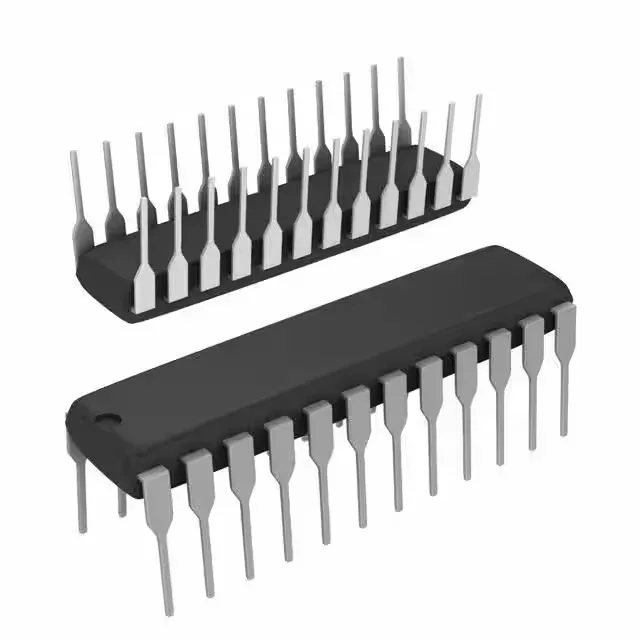
The Microchip ATF22V10C-15PI is an electrically erasable programmable logic device (EE PLD) from the industry-standard 22V10 family, offering 10 macrocells in a 24-pin DIP package with a 15 ns propagation delay. It operates on a 5V supply and is intended for through-hole board designs where glue logic replacement, address decoding, or state-machine implementation is needed without a full CPLD or FPGA.
15 ns speed — the timing constraint
The 15 ns propagation delay (tpd) sets the maximum system clock frequency this part can support in registered mode. For a typical state machine running at 50 MHz, the 15 ns delay leaves about 5 ns of timing margin after setup/hold — tight but workable. In combinatorial paths the delay is the same 15 ns pin-to-pin, so the part fits in 33 MHz bus decode or address-latching applications without wait states.
The ATF22V10C-15PI is listed as Obsolete. Microchip no longer manufactures this device in the 24-pin DIP package variant. For existing BOM lines, the only sourcing channel is the independent distribution market — surplus stock, new-old-stock, or broker inventory. No official successor has been recorded for this specific order code. The 15 ns speed grade and 24-pin DIP footprint limit drop-in replacements to other 22V10 family parts from the same era, which carry their own obsolescence risk.
10 macrocells — logic density and fit
Ten macrocells, each configurable as registered or combinatorial output, give the 22V10 architecture its flexibility. Each macrocell contains one flip-flop with programmable polarity and output-enable control. For a typical address decoder consuming 4 macrocells or a 4-state machine using 5 macrocells, the remaining 5–6 macrocells can handle output inversion or enable logic. The 10-macrocell count is the hard ceiling — a design that requires 11 registered outputs will not fit without a larger device.
Package and supply — legacy through-hole design
Housed in a 24-pin DIP (0.300 inch body width) with through-hole mounting, the ATF22V10C-15PI is a legacy footprint for socketed or wave-solder boards. The single 5V supply rail simplifies power distribution — no core or I/O voltage split.