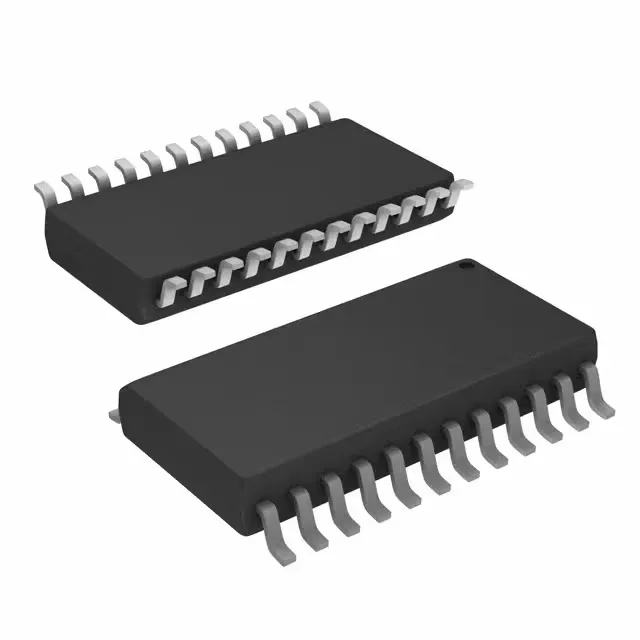
10 ns propagation delay — glue-logic timing budget
The Microchip ATF22V10C-10SI is an electrically erasable PLD (EE PLD) from the 22V10 family, delivering a 10 ns propagation delay from input to combinatorial output. That 10 ns ceiling sets the maximum system clock frequency the part can support in a registered configuration — typically around 83 MHz with zero wait states, though the actual margin depends on the external routing and fan-out. For address decoding, bus arbitration, or state-machine glue logic in a 5V system, the 10 ns speed keeps the timing closure straightforward as long as the upstream and downstream devices have comparable output-enable and setup times.
10 macrocells — logic capacity and architecture
Ten macrocells give the ATF22V10C-10SI enough fabric for small-to-medium combinatorial and registered logic blocks — think a 4-bit counter with decode, a simple UART baud-rate generator, or a handful of chip-select equations. Each macrocell includes a programmable AND/fixed OR array, a D-type flip-flop, and output polarity control. The 22V10 architecture is well-documented and supported by legacy design tools; the JEDEC fuse map is directly compatible with earlier 22V10 OTP and UV erasable parts.
Microchip lists the ATF22V10C-10SI as Obsolete. For BOM lines that still require the exact ATF22V10C-10SI, the only channel is independent distribution — sealed reels and tube lots are sourced per RFQ, with date-code and condition verified before shipment.
5V-only operation — supply rail fit
The ATF22V10C-10SI is a 5V-only device. It will not tolerate a 3.3V VCC; the input thresholds are TTL-compatible, so a 3.3V logic output can drive the inputs if the 3.3V device's VOH meets the 2.0 V VIH minimum. Outputs swing rail-to-rail (0 V to 5 V), which may overstress a 3.3V-only receiver without a series resistor or level shifter. In a legacy 5V backplane or ISA-bus-style design, the 5V rail is a direct fit; in mixed-voltage boards, budget for translation.