10 ns propagation delay — timing budget for address decoding
The ATF22V10C-10NM/883 is a 22V10-architecture EE PLD from Microchip, with a 10 ns propagation delay from input to combinatorial output. That 10 ns sets the timing margin in a memory-address decode or fast state-machine path: at a 50 MHz system clock the period is 20 ns, so the PLD consumes half the cycle just in tpd. The remaining margin must cover the memory access time, routing delay, and setup time of the next stage. For a 100 MHz bus this part is too slow; for a 33 MHz or slower bus it fits comfortably.
Hermetic 28-CLCC — the high-reliability differentiator
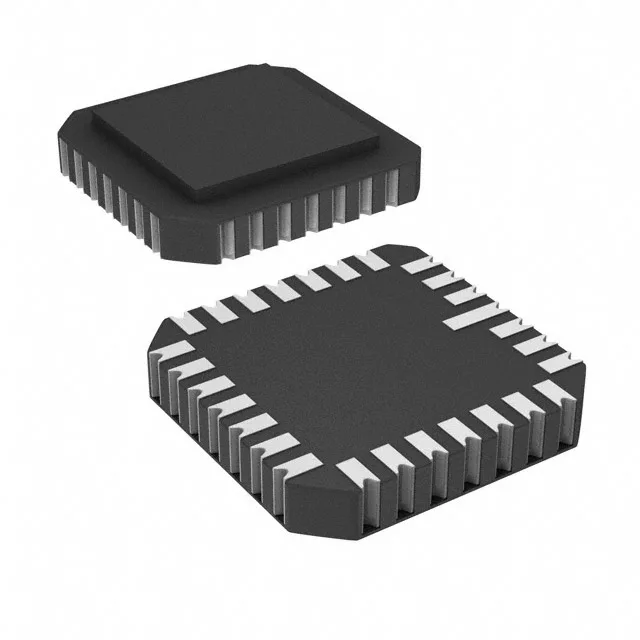
The 28-CLCC (ceramic leadless chip carrier) package, with a body size of 11.45x11.45 mm, is the defining feature for this variant. Ceramic construction and hermetic sealing make it suitable for environments where moisture, thermal cycling, or outgassing would degrade a plastic package — avionics, satellite, downhole, and military systems. The surface-mount LCC footprint requires a reflow profile matched to the ceramic body's thermal mass; the 28 pads are on a 50-mil pitch around the perimeter. No exposed thermal pad — heat conducts through the package leads and the board copper.
5V-only supply — no core/IO split
This PLD runs on a single 5V rail. There is no separate core or I/O voltage — the entire logic array and I/O buffers operate from 5V. That simplifies the power tree but means the outputs swing 0-to-5V, which is incompatible with 3.3V or lower logic families without a level translator. The 5V input threshold is TTL-compatible, so a 3.3V driver with 5V-tolerant output can drive it directly if the high-level voltage exceeds 2.0V.