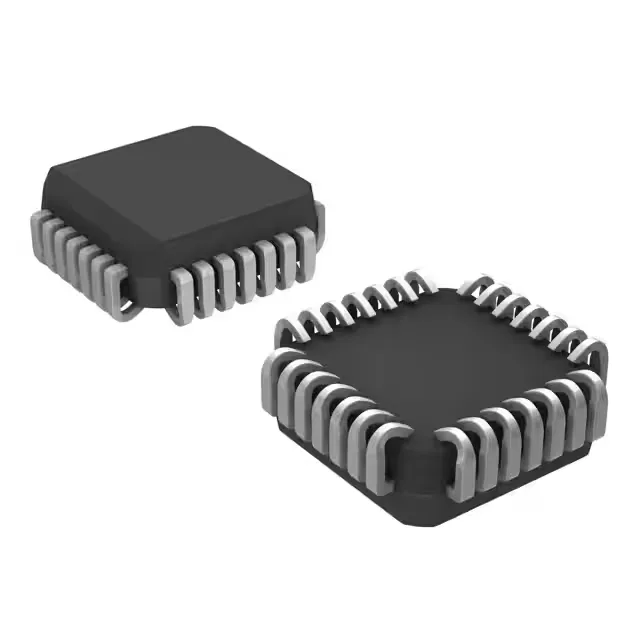
The Microchip ATF22V10BQL-20JC is an electrically-erasable programmable logic device (EE PLD) from the 22V10 family, offering 10 macrocells and a 20 ns propagation delay. It operates from a single 5V supply and comes in a 28-PLCC (J-Lead) package, surface-mount. This class of PLD is typically used for board-level glue logic — address decoding, state machines, bus arbitration — in industrial controllers, telecom line cards, and legacy embedded systems where a small, fast, reprogrammable logic block replaces multiple 7400-series TTL parts.
20 ns speed — timing margin in a 5V system
The 20 ns propagation delay (tpd) sets the maximum clock frequency for registered logic at roughly 50 MHz in a typical synchronous design. For combinatorial paths, the 20 ns window includes input-to-output delay through the AND-OR array and macrocell; a system with a 25 MHz clock has 40 ns of cycle time, leaving 20 ns of margin after the PLD delay for trace and buffer delays. That margin shrinks fast if the design uses cascaded PLDs or long board traces.
10 macrocells — logic capacity for moderate consolidation
Ten macrocells, each with a programmable flip-flop (D/T/JK) and output polarity, can absorb roughly 20–30 SSI/MSI logic gates worth of combinatorial and registered functions. Typical applications include a 3-to-8 decoder with registered outputs, a 4-bit counter with load and clear, or a simple state machine with 8–10 states. Designs that exceed 10 macrocells or need more than 20–30 product terms per output will overflow this device.
28-PLCC J-Lead — board footprint and rework
The 28-PLCC package (11.51 x 11.51 mm body) uses J-leads formed under the body, requiring a solder pad pattern with a central thermal pad (typically connected to ground) and a 1.27 mm pitch. The J-lead profile is less prone to tombstoning than gull-wing, but inspection of the solder joint under the package requires X-ray or a side-view scope. Rework with hot air is straightforward — the PLCC body lifts cleanly when the solder reflows, and the pads are robust to a few removal cycles.