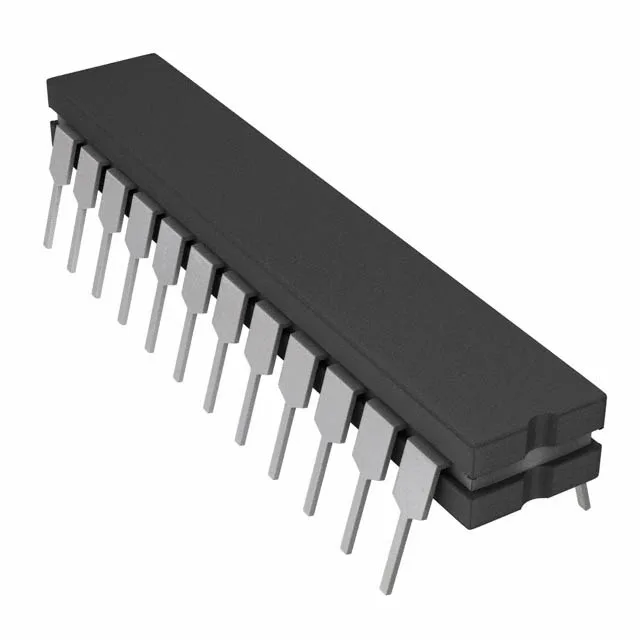
The Microchip ATF22V10B-10GM/883 is an electrically erasable programmable logic device from the industry-standard 22V10 architecture, offering a 10 ns propagation delay across 10 macrocells. This is the /883 variant, indicating processing and screening for military and high-reliability applications — the ceramic package and extended temperature range suit it for avionics, missile guidance, satellite subsystems, and downhole instrumentation where plastic-packaged PLDs would not survive the environment.
10 ns speed grade — timing budget for address decode and state machines
The 10 ns propagation delay (tPD) is the time from input through the AND-OR array to a registered or combinatorial output. In a typical address decoding application feeding a memory chip select, that 10 ns eats into the total access-time budget — a 70 ns SRAM with a 10 ns decode leaves 60 ns for the memory itself. For state-machine clocking, the 10 ns tPD sets a ceiling on how fast you can sequence through states before the registered outputs settle. The 22V10 architecture gives you 10 macrocells that can be individually configured as registered or combinatorial, which is enough for medium-complexity glue logic without cascading multiple devices.
Ceramic DIP — assembly and reliability considerations
The 24-CDIP package (0.300-inch body, 7.62 mm row spacing) is a through-hole ceramic dual-in-line with hermetic sealing. Unlike plastic DIPs, the ceramic body does not absorb moisture, so no bake-out is needed before soldering. The lead frame is typically Kovar with gold plating — compatible with hand-soldering, wave-soldering, or socket insertion. For a PCB layout, the 0.100-inch pin pitch and 0.300-inch row spacing match standard DIP footprints; the hole diameter should accommodate the 0.018-inch nominal lead width with adequate annular ring. The ceramic package also handles higher operating temperatures than plastic — relevant for the /883 temperature grade.
For a sustaining BOM that already qualifies this part, there is no urgency to find a drop-in replacement or stockpile inventory.