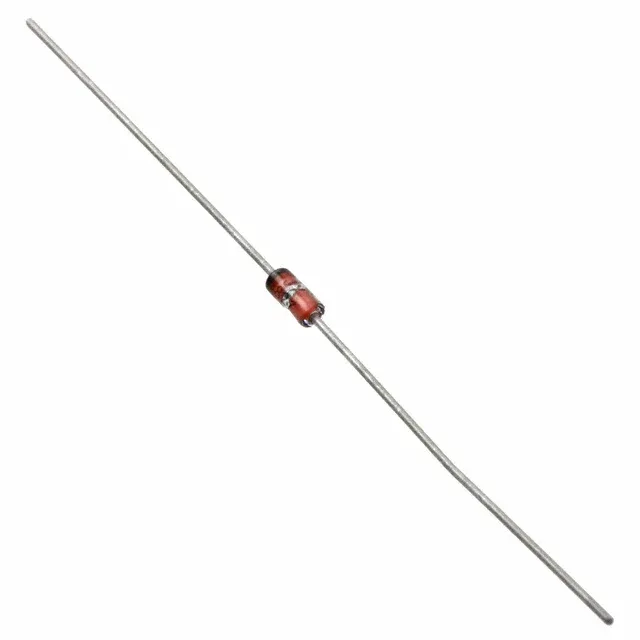
The 1N751A-1E3 is a 5.1 V zener diode in a DO-35 axial-lead package, rated for 500 mW maximum power dissipation. The ±5% tolerance on the zener voltage means the actual Vz across a production batch will fall between about 4.85 V and 5.36 V — tight enough for most reference and clamping roles, but not a precision voltage reference. The 14 Ω maximum impedance (Zzt) at the test current tells you the dynamic resistance; in a shunt regulator circuit that impedance adds to the output resistance, so budget for a few tens of millivolts of load-regulation error if the current varies.
The 175°C upper limit is unusual for a small-signal zener — most 500 mW devices stop at 150°C. That extra headroom matters when the diode is mounted near a hot power stage or in a sealed module with limited convection. Derate the 500 mW maximum linearly above 25°C; at 175°C the allowable dissipation drops to zero.
(not tape-and-reel) in the DO-204AH / DO-35 axial-lead package. The through-hole body is 0.018 inch diameter leads on 0.200 inch lead spacing — standard for hand-insertion or wave-solder assembly. No moisture sensitivity level to track; no bake required before reflow because there is no reflow.
The 1N751A-1E3 is the lead-free / RoHS-compliant variant of the classic 1N751A; if your BOM still calls out the tin-lead version, this is the drop-in replacement that meets current environmental requirements.