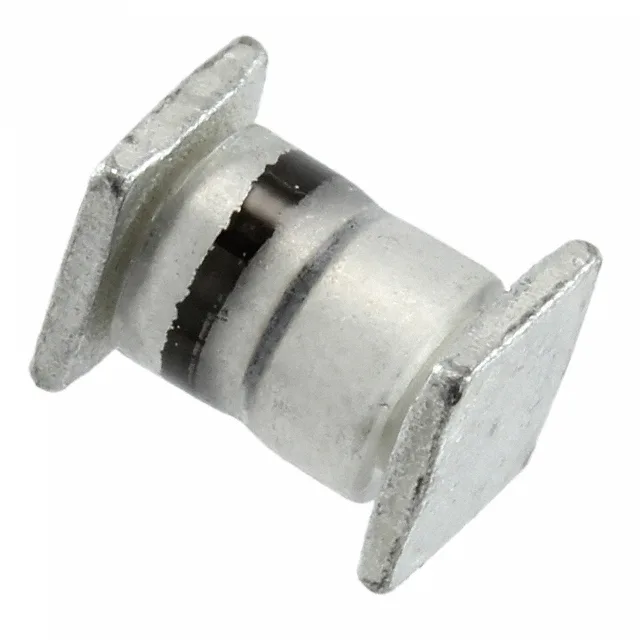
The 1N6643US comes in a surface-mount SQ-MELF, B case, supplier device package D-5B. This hermetic ceramic package is built for high-reliability environments — the MELF barrel sits flat on the board and the metalized end caps take the solder joint, so the diode handles thermal cycling without cracking the body. The D-5B footprint is compact enough for dense layouts but the end-cap pads need a full-width land pattern to carry the 300 mA average current without lifting the termination.
Switching speed and recovery behaviour
This is a fast recovery diode — the JEDEC classification is Fast Recovery =< 500ns, > 200mA (Io), but the actual reverse recovery time (trr) is 20 ns. That 20 ns number is what matters for a 50 V, 300 mA rectifier: it means the diode sweeps out stored charge fast enough to keep switching losses low in a 100–200 kHz converter, and it avoids the snap-off ringing you get with an ultrafast part in a low-current snubber. The 5 pF junction capacitance at 0 V, 1 MHz adds negligible AC loading in signal or clamp applications.
Thermal and electrical limits
Junction temperature range is -65°C to 175°C — that is the full military temperature band. The 1.2 V forward drop at 100 mA is typical for a fast-recovery die in this voltage class; at the 300 mA rated average current the Vf will climb a bit, but the 175°C Tj max gives headroom for conduction losses in a 70°C ambient. Reverse leakage is 50 nA at 50 V, 25°C — it doubles roughly every 10°C, so at 125°C expect around 3 µA, still well within the leakage budget for most precision analog or hold-up capacitor circuits.