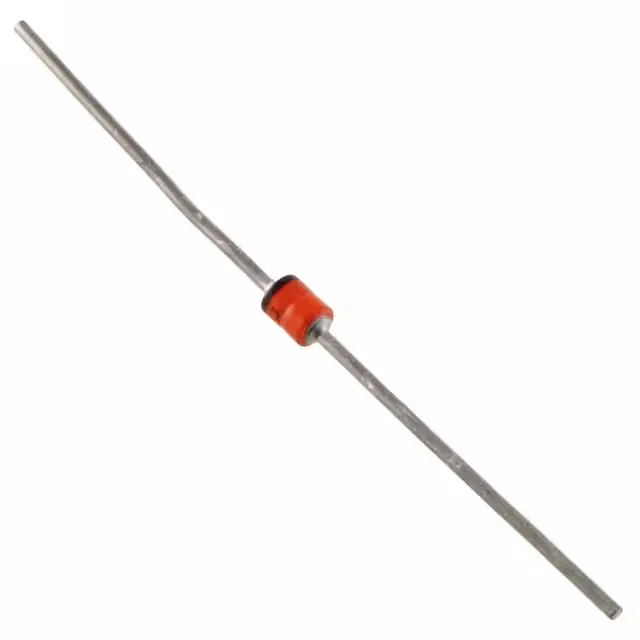
The 1N6637 is a 5.1 V Zener diode rated for 5 W continuous power dissipation. For a 5.1 V rail, that power rating translates to a maximum steady-state current of roughly 980 mA — but the real limit is set by the junction temperature and the heatsinking of the axial lead in free air. In a voltage-clamp application, the 5 W ceiling means the diode can absorb short-duration surges well above the DC limit, as long as the average power stays under the thermal budget. The 400 Ohm max impedance (Zzt) at the test current is typical for a 5.1 V Zener in this power class. Higher Zzt means the regulation voltage shifts more with current — budget a few hundred mV of variation between light and full load if you are using it as a shunt reference.
E, Axial through-hole package (also called DO-41 or similar body) — the leads are 0.025-inch diameter tin-plated copper, meant for PCB through-holes or point-to-point wiring in a terminal block. The -65°C to 175°C operating range qualifies it for military, aerospace, or downhole applications where the ambient temperature exceeds the commercial or industrial band.
Leakage and forward characteristics
Reverse leakage is 5 µA max at 1 V reverse — that is low enough to not drain a battery in standby, but rises exponentially with temperature. At 175°C, expect leakage to be several orders higher, so factor that into the thermal design if the diode is biased near the Zener voltage in a hot environment. Forward voltage is 1.5 V max at 1 A — the diode conducts as a standard rectifier in forward bias, with the 1.5 V drop at 1 A representing about 1.5 W of forward conduction loss. That is within the 5 W power rating but reduces the headroom for reverse Zener dissipation if the diode sees AC or bidirectional current.