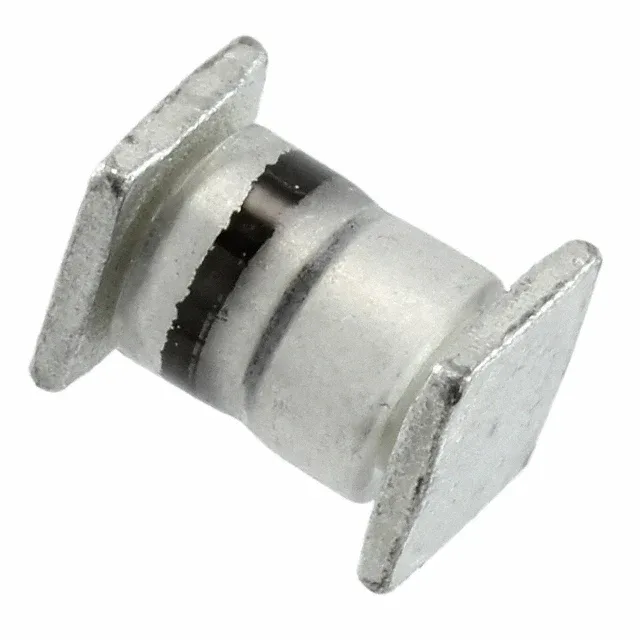
900 V blocking, 1.4 A average — the operating envelope for high-voltage snubber and PFC circuits
The 1N6630US: Rated for 900 V DC reverse voltage and 1.4 A average rectified current, this diode fits into the output rectifier stage of a high-voltage flyback converter or as a clamp diode in a 3-phase motor drive snubber. The 50 ns reverse recovery time classifies it as a fast recovery type (trr ≤ 500 ns at Io > 200 mA per) — the switching losses in a hard-switched 100 kHz PFC boost stage stay manageable because the recovery charge is low enough to reduce the overlap interval during turn-off. Forward drop is 1.7 V maximum at 3 A pulsed current. That is higher than a Schottky of similar current rating, but the 900 V blocking voltage requires a PIN or epitaxial structure — the conduction loss trade-off is acceptable in circuits where the diode spends most of its time reverse-biased.
Hermetic SQ-MELF — the package that buys you sealed-environment reliability
The SQ-MELF, E package — also designated D-5B — is a hermetic glass surface-mount package. Unlike plastic-packaged diodes, the glass-to-metal seal keeps moisture and ionic contaminants out of the junction. This matters for avionics (unpressurized bays), downhole instrumentation, or outdoor telecom rectifiers where conformal coating alone is not enough to prevent electrochemical migration. For the 1.4 A average current at 150°C junction limit, a 1-oz copper pad of at least 25 mm² per termination is a safe starting point for the layout.
This is the full military-grade temperature envelope — the diode keeps its rated blocking voltage and recovery time down to -65°C, and the 150°C upper limit allows continuous operation in a 105°C ambient with self-heating margin. Reverse leakage at 100 V is 4 µA typical at 25°C, but expect it to double roughly every 10°C above 100°C junction — budget the leakage power into the thermal calculation if the diode runs near the 150°C limit.