What the 45 ns trr and 2.3 A rating actually decide
The 1N6628US/TR is a fast recovery rectifier with a reverse recovery time of 45 ns and an average rectified current rating of 2.3 A. The 45 ns trr puts it in the class that switches cleanly in a 100 kHz power supply without the diode staying on long enough to short the transformer secondary — the stored charge clears fast enough that the reverse recovery spike stays below the FET's avalanche rating. The 2.3 A average is the DC load it can carry in a continuous conduction mode boost or flyback stage; the forward drop of 1.5 V at 4 A means the conduction loss at 2.3 A is roughly 3.5 W, which the SQ-MELF package sinks through the board copper.
600 V blocking and the thermal envelope
The 600 V reverse voltage covers 400 VDC bus rails (typical in power-factor-correction stages) with derating margin. Reverse leakage is 2 µA at that 600 V stress — negligible at room temperature but worth a thermal check if the junction runs near the 150°C max. The junction temperature range of -65°C to 150°C is the military-grade band; this diode is comfortable in an avionics power supply or an outdoor telecom rectifier that sees -40°C startup.
SQ-MELF footprint — board-fit note
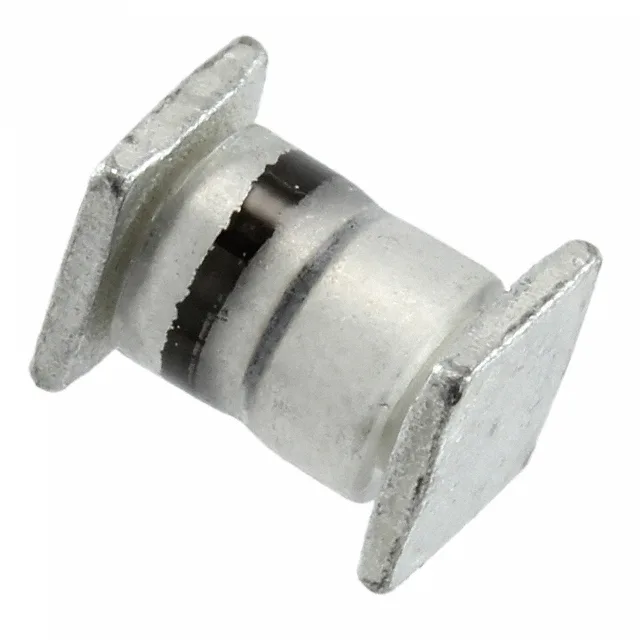
The SQ-MELF, E package is a surface-mount, square-ended MELF with metallized terminations — no gull-wing leads to inspect, but the solder joint is purely on the end caps. The supplier device package is D-5B, which is Microchip's own code for this SQ-MELF outline. On the board, the pad geometry should match the D-5B land pattern: the end-cap wets to the pad, and the body sits above the board. The 40 pF junction capacitance at 10 V, 1 MHz is low enough that switching losses in a 200 kHz converter are secondary to the trr losses.