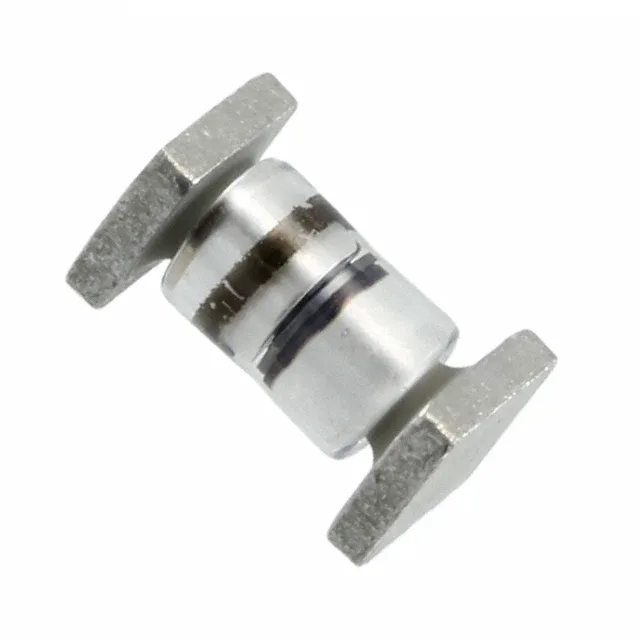
660 V / 1.75 A fast recovery — the switching application fit
The 1N6628US is a 660 V, 1.75 A fast recovery rectifier in a hermetic SQ-MELF package. Its 30 ns reverse recovery time (trr) places it in the class of diodes that can serve as the boost diode in a 100-200 kHz PFC stage, a snubber clamp in a flyback converter, or the output rectifier in a 400 VDC-bus telecom supply — where the recovery charge must stay low enough to avoid excessive switching loss in the MOSFET. The junction temperature range of -65 to +150 °C covers military and aerospace thermal profiles. A 400 VDC bus with 1.75 A average leaves derating margin for a 3-phase input stage that sees 800 V transients; the 660 V Vr rating handles those without avalanche stress.
Package and board integration — SQ-MELF hermetic seal
The SQ-MELF (A-MELF) package is a surface-mount, solderable, hermetic ceramic body with metallized end caps. It survives the thermal cycling of military-grade boards better than a plastic SMC or SMB — the coefficient of thermal expansion matches alumina substrates used in hybrid microcircuits. The 40 pF capacitance at 10 V reverse bias means the diode does not add significant capacitive loading in snubber or clamp positions. For a reflow line, the pick-and-place feeder must handle the MELF cylindrical body; the end-cap solder profile is the same as a standard 0805 or 1206 chip resistor.
Forward drop and recovery trade-off
At 1.35 V maximum forward drop at 2 A, the conduction loss is moderate — about 2.7 W at the rated 1.75 A average. The 30 ns trr is the reason the Vf is higher than a standard recovery rectifier; the lifetime killing that gives fast recovery also raises the on-state voltage. In a 200 kHz boost converter, the switching loss saved by the fast recovery outweighs the conduction penalty by a factor of 3-5×.