Switching-speed and recovery behaviour
The 1N6620 is a fast recovery rectifier with a reverse recovery time (trr) of 30 ns, placing it well inside the Fast Recovery =< 500ns, > 200mA (Io) classification. This 30 ns trr means the diode exits conduction and blocks reverse voltage quickly — the stored charge clears in roughly one switching cycle of a 16.6 MHz waveform, so the reverse-recovery current spike is narrow enough to keep switching losses low in a 100-200 kHz power stage. The junction capacitance is 10 pF at 10 V, 1 MHz — a small value that limits the capacitive displacement current during voltage transients. In a snubber design for a 220 V rail, this capacitance contributes about 2.2 nC of charge per 220 V step, which is negligible compared to the stored charge from forward conduction.
Forward and blocking ratings at temperature
Rated 1.2 A average rectified current with a forward voltage of 1.4 V maximum at that current. At 1.2 A, the conduction loss is 1.68 W — the axial-lead package relies on the PCB copper and airflow to keep the junction below 150°C. The 500 nA reverse leakage at 220 V is measured at room temperature; expect leakage to rise with junction temperature, roughly doubling every 10°C, so at 125°C the leakage may approach 32 µA — still well below the 1.2 A forward rating for blocking duty. The 220 V DC reverse voltage maximum is the peak repetitive blocking voltage — the diode can hold off 220 V continuously without avalanche, but any transient above that requires an external clamp or snubber.
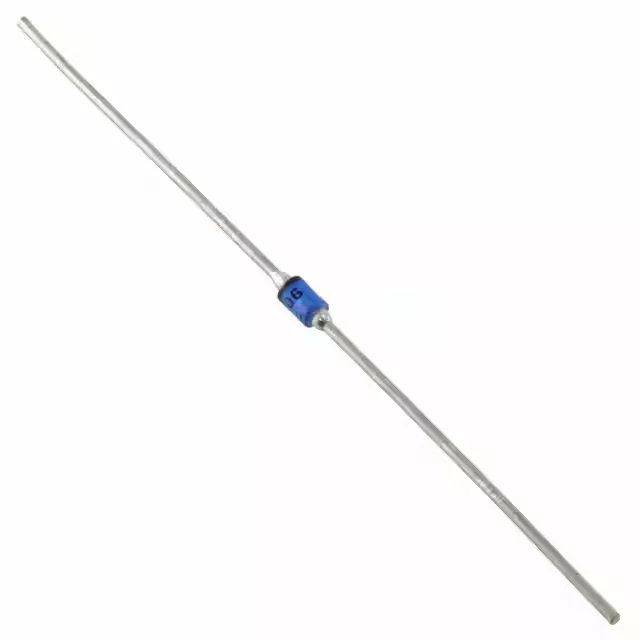
Supplied in a through-hole axial-lead package (case style A, axial). The leads are tin-plated copper; the body is molded epoxy. For rework, the axial leads require a plated through-hole diameter of about 0.8-1.0 mm on the PCB.