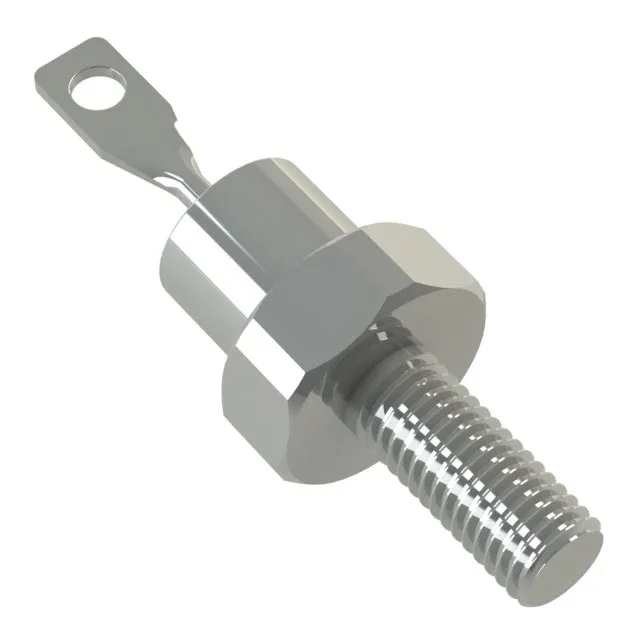
The 1N6391 is a 45 V, 25 A Schottky rectifier in a DO-203AA (DO-4) stud-mount package, qualified to MIL-PRF-19500/553. The 45 V reverse voltage covers 24 V and 28 V rails with margin; the 25 A average rating is the DC output current the junction can sustain with the stud bolted to a heatsink. Forward voltage is 500 mV at 5 A — at 25 A the Vf will be higher due to the resistive slope of the Schottky barrier, but the 500 mV figure at 5 A gives a baseline for conduction loss in the lower part of the load range.
Fast recovery in a Schottky — why the speed spec matters
The speed classification is Fast Recovery =< 500 ns at > 200 mA. For a Schottky diode, recovery is majority-carrier dominated — there is no stored charge to sweep out, so the 500 ns ceiling is conservative and reflects the test circuit's turn-off conditions rather than the intrinsic physics. In practice a Schottky of this voltage class switches in tens of nanoseconds, which keeps reverse-recovery losses negligible in a 50 kHz or 100 kHz converter. Junction capacitance is 2000 pF at 5 V reverse bias. That capacitance stores charge that must be delivered each switching cycle; at 100 kHz the capacitive switching loss is roughly 0.5 × C × V² × f, or about 0.2 W at 45 V — a manageable fraction of the total dissipation.
Active production and military pedigree
RoHS non-compliant — the leads and internal construction use tin-lead solder and plating. For a military or high-reliability BOM that allows lead-bearing finishes, this is the correct part; for a RoHS-mandated line, a tin-plated alternative would be needed.
Stud-mount integration — what the package tells you
DO-203AA (also known as DO-4) is a 1/4-28 threaded stud package. The anode is the stud and base; the cathode is the top terminal. The stud must be torqued into a tapped heatsink or chassis with a thermal compound interface — the junction-to-case thermal path is through the stud, so the mounting torque and surface finish directly set the thermal resistance. The 175°C maximum is typical for a Schottky; leakage current doubles roughly every 10°C above 25°C, so at 150°C junction the 1.5 mA reverse leakage at 45 V becomes a significant contributor to self-heating and must be included in the thermal budget.