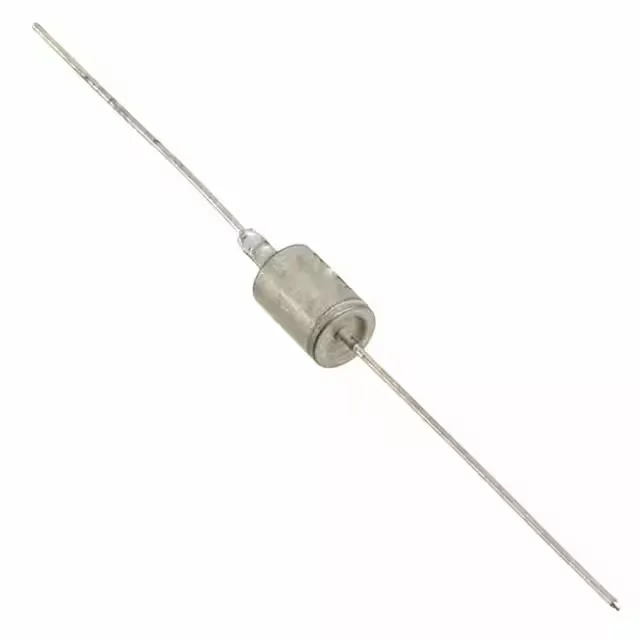
Zener transient suppressor – 1500W, 9.4V breakdown, bidirectional
Its minimum breakdown voltage of 9.4V and reverse standoff of 8V make it a fit for clamping on 8V nominal rails where the transient must be shunted before reaching downstream silicon. This is a single-channel bidirectional device, meaning it clamps both polarities symmetrically — useful on AC-coupled lines or where the signal swings through zero and you need protection in both directions without a series diode.
Peak pulse current and clamping – what 100A and 11.6V mean on your rail
At the 10/1000µs test waveform, the 1N6365/TR clamps a 100A peak pulse current to a maximum of 11.6V. That 2.2V window between the 9.4V breakdown and the 11.6V clamp voltage is the dynamic resistance of the Zener junction — the tighter this window, the less over-voltage the protected circuit sees. For a 5V logic rail with an 8V standoff, the 11.6V clamp is well above the rail but still below the typical absolute maximum of most 12V-rated ICs. The 1500W peak pulse rating is derated with temperature; the junction can reach 175°C, but the pulse power capability drops linearly above 25°C. For repetitive surges, the average power dissipation must stay within the DO-13 package's thermal limits — this part is designed for infrequent transients, not continuous clamping.
Active production – DO-13 through-hole, tape and reel
Because this is an active, single-sourced Microchip part, the BOM risk is low but not zero. No official second-source or direct replacement is listed.
Mounting and thermal – the DO-13 can and what it needs on the board
The DO-13 package is a through-hole metal can with two axial leads. The cathode end is typically marked with a band; for a bidirectional Zener, polarity marking is less critical because it clamps both ways. Thermal management: the DO-13 case conducts heat through the leads into the PCB copper. For the 1500W pulse rating, the junction temperature rise during the pulse is self-limiting — the thermal mass of the silicon die absorbs the energy. For sustained operation near the 175°C limit, the lead solder joints and board copper must handle the steady-state dissipation without fatigue.