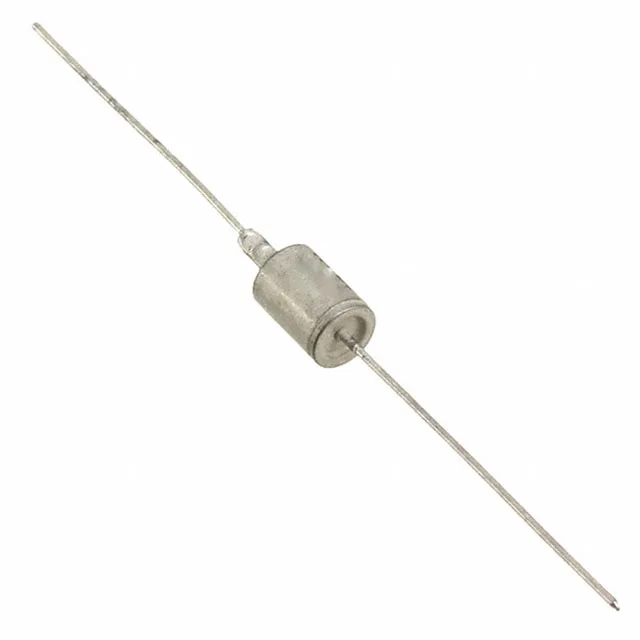
What is the 1N6361/TR and what does it protect?
It delivers a peak pulse power rating of 1500W (1.5kW) under the 10/1000µs waveform, clamping at 25.2V maximum when the surge current hits 50A. The minimum breakdown voltage is 21.2V, with a typical reverse standoff of 18V — meaning the diode starts conducting well before the protected rail sees damaging overvoltage.
The 21.2V breakdown minimum sets the threshold where the diode transitions from high-impedance to low-impedance. Below that, leakage is negligible; above it, the diode shunts the surge to ground. Pair it with a TVS or MOV for primary-side protection if the application involves line transients.
Package and temperature envelope
Housed in a DO-13 through-hole package, the 1N6361/TR is a metal-can axial-lead design suited for high-reliability soldering and easy retrofit into existing through-hole boards. Derate the peak pulse power above 25°C per the datasheet curve — at 175°C the 1500W rating drops significantly.
This is a standard catalog part, not a short-lead custom device. For BOM planning, the active status removes the urgency of a last-time-buy calculation. No direct second-source is listed, but the DO-13 package and 1.5kW rating are common across several manufacturers — a cross-reference search can identify alternatives if supply tightens.