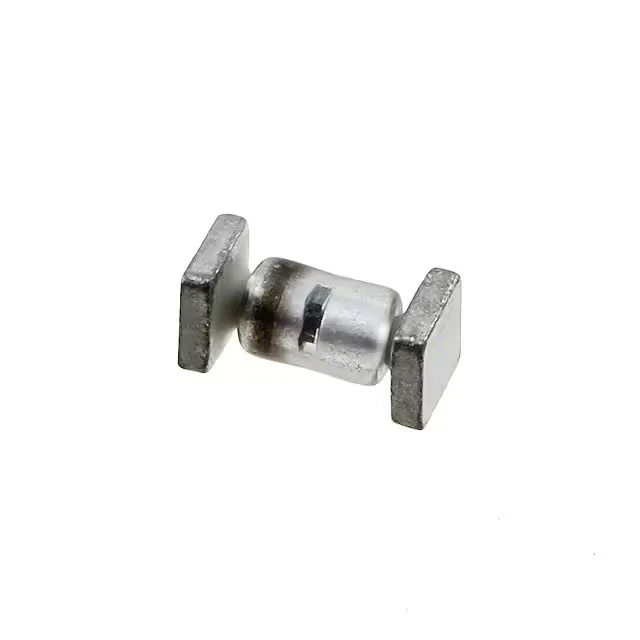
9.1 V regulation in a hermetic MELF
The 1N6323US is a 9.1 V Zener diode rated for 500 mW continuous power dissipation, housed in a hermetically sealed SQ-MELF package (B suffix). The ±5% tolerance on the nominal voltage means the actual Zener voltage falls between 8.645 V and 9.555 V at the test current — a band tight enough for reference or clamping in precision analog rails. The junction sees the full range in avionics, down-hole tools, or satellite power buses where the ambient swings from cold-soak to near-engine-bay heat.
Surface-mount hermetic — the SQ-MELF footprint
The SQ-MELF (B case) is a surface-mount package with metallized end caps, no leads to fatigue under thermal cycling. Solder the diode flat to the board pad — the end-cap solder fillet carries the current; the body is ceramic-glass sealed against moisture and particle ingress. Board layout should keep the trace width adequate for the 500 mW dissipation at the operating ambient. For a 9.1 V rail the Zener conducts roughly 55 mA at full rated power; the copper pad area under the package acts as the primary heat spreader.
Leakage and forward characteristics
Reverse leakage is specified at 1 µA maximum with 7 V applied across the junction — 2.1 V below the nominal Zener voltage, so the diode stays well into the leakage region before breakdown. Forward voltage drop is 1.4 V maximum at 1 A forward current, a figure that matters if the diode sees surge or reverse-polarity events. Maximum Zener impedance (Zzt) is 500 Ohms. This is the dynamic resistance at the test current; a higher Zzt means the regulation voltage shifts more with current variation, so the diode is best paired with a current source or ballast resistor for reference duty.