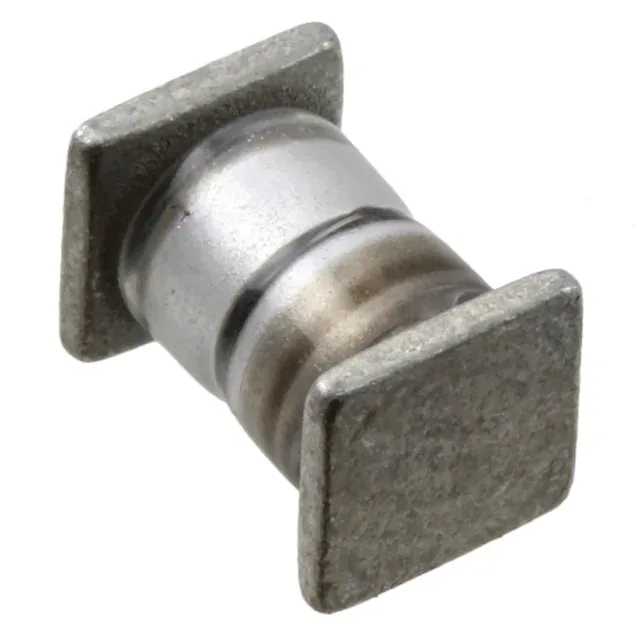
The 1N6310US comes in a SQ-MELF, B package — a surface-mount glass-passivated form factor with end-cap metallization, suited for automated pick-and-place assembly on standard reflow profiles. The B suffix indicates a specific body size within the MELF family; the solderable end caps demand a uniform solder paste deposit and adequate pad geometry to avoid tombstoning during reflow.
Key ratings and what they mean for the BOM
With a nominal zener voltage of 2.7 V and a ±5% tolerance, this diode holds the regulation point within 135 mV of the target — tight enough to bias a low-voltage rail or clamp a signal line. The 500 mW power dissipation ceiling means it can handle up to roughly 185 mA of zener current before junction temperature becomes the limit; the 30-ohm impedance at the zener knee means the regulation stiffens as current increases, a common characteristic in low-voltage references.
Temperature grade and environment
Rated for continuous operation from -65°C to 175°C, the 1N6310US covers the full military temperature range. The upper limit suits high-reliability applications such as avionics, downhole instrumentation, or engine-bay electronics where ambient temperatures exceed the commercial 85°C ceiling. The SQ-MELF's glass-passivated junction is inherently moisture-resistant, though the part does not carry an explicit IP rating.
Reverse leakage and forward characteristics
Reverse leakage is specified at 60 µA maximum when 1 V is applied across the junction — a key parameter for battery-powered circuits where the leakage current directly impacts standby drain.