30 ns reverse recovery — where this speed matters
The 30 ns trr qualifies this as a fast recovery diode per the JEDEC definition (≤500 ns at >200 mA). That recovery time lets it switch at 100 kHz in a continuous-conduction boost or flyback converter without excessive reverse-recovery losses. At 2 A average forward current and 100 V reverse blocking, the 1N6080/TR fits output rectification in 48 V telecom rectifiers, 24 V industrial SMPS, and auxiliary supply rails where the switching frequency stays under 150 kHz.
Temperature range and junction limits
Rated for -65°C to 155°C junction temperature — this covers the full military temperature band. In a sealed enclosure with 85°C ambient, the junction-to-ambient thermal path still has 70°C headroom before hitting the absolute maximum. Reverse leakage is 10 µA at 100 V and 25°C junction. Leakage doubles roughly every 10°C rise; at 125°C junction it reaches about 160 µA — still acceptable for most rectifier circuits, but worth factoring into the standby power budget.
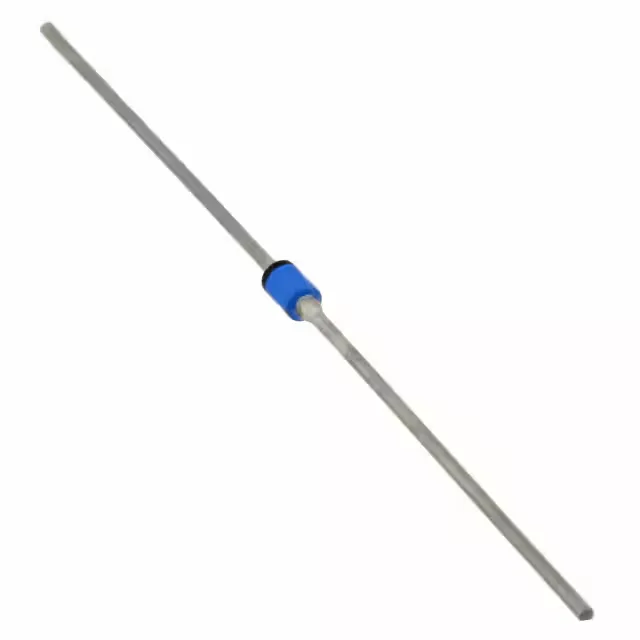
Supplied in the A, Axial package on tape and reel (TR suffix) — the through-hole body mates with standard 0.040-inch diameter lead holes on a 0.100-inch pitch. Wave-solder profile is the same as any axial-lead diode; no special handling beyond standard ESD precautions. The 1.5 V forward drop at 37.7 A is a surge-condition figure, not the continuous rating. At the 2 A continuous operating point, the forward drop is typically below 1.0 V — the exact value depends on junction temperature and is best read from the Vf vs If curve in the datasheet.