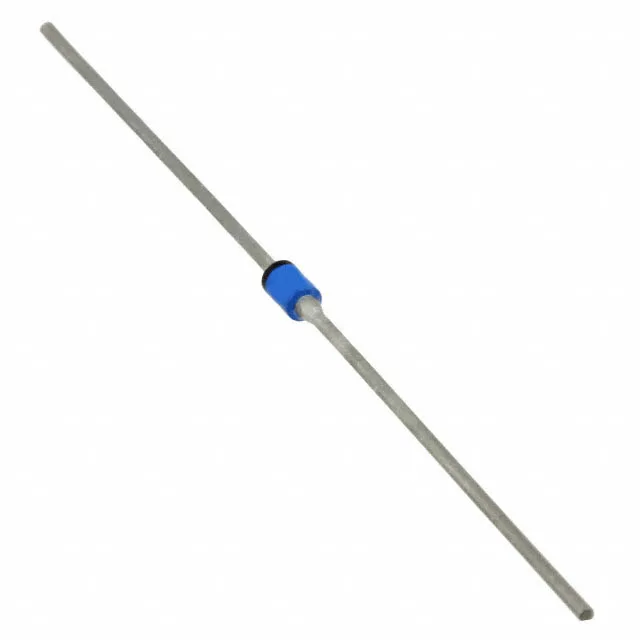
30 ns recovery — what it buys you in a switching supply
The 1N6078/TR is a standard-technology fast recovery rectifier with a reverse recovery time of 30 ns, rated for average forward current of 1.3 A and a maximum reverse voltage of 150 V. That 30 ns trr means the diode stops conducting almost immediately when the voltage reverses — critical in a 50-100 kHz flyback or forward converter where the recovery tail would otherwise dump shoot-through current into the switching transistor. The 1.76 V forward drop at 18.8 A surge tells you the die can handle brief inrush without thermal runaway, but the steady-state conduction loss at 1.3 A is what drives the heatsink decision.
Axial package — rework and board-fit reality
Through-hole axial package (A, Axial) means the body sits above the board with leads bent 90° for insertion or used in point-to-point wiring. The tape-and-reel format (TR) is the production packaging — the leads are taped to the carrier strip for automated insertion, not cut and formed for hand placement. If you are hand-stuffing a prototype, expect to cut the tape and form the leads yourself; the axial body has no orientation key beyond the cathode band, so verify polarity before soldering.
Junction temperature range and derating
Junction temperature spans -65°C to 155°C, which covers military cold-soak and hot-bench conditions without derating the 1.3 A average current until you cross 100°C or so — the exact derating curve is in the datasheet. Reverse leakage is 5 µA at 150 V reverse, negligible at room temperature but it doubles roughly every 10°C; at 125°C junction the leakage will be a meaningful fraction of the average current and shifts the thermal balance.