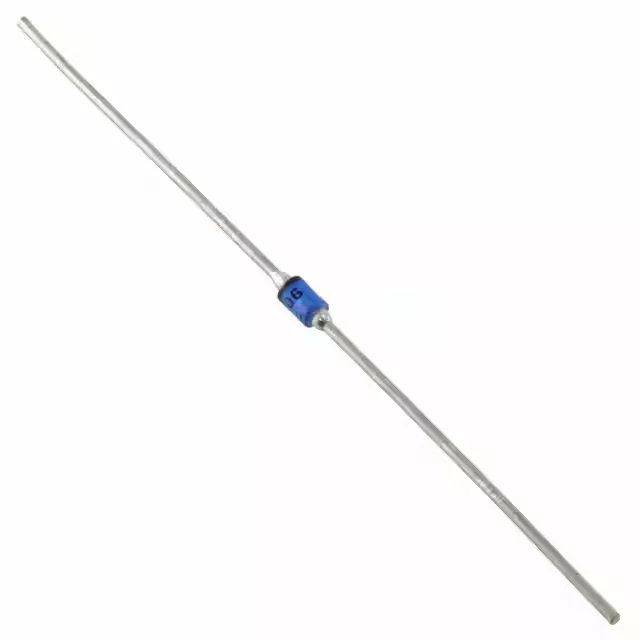
1.3 A fast recovery rectifier in the axial leaded package
The 1N6077: It is classified as a fast recovery type (trr ≤ 500 ns at Io > 200 mA), making it suitable for switching power supplies and flyback snubber circuits where the recovery charge needs to be low to limit switching losses.
30 ns recovery and 1.76 V forward drop at 18.8 A surge
The 30 ns trr is the time it takes the diode to switch from forward conduction to reverse blocking — a 30 ns window means the diode stops conducting within that interval, which keeps the reverse-recovery current spike short and the switching node ringing manageable in a 100 kHz or faster converter. Forward voltage is specified at 1.76 V maximum when the diode is pulsed to 18.8 A — this is a surge condition, not the continuous 1.3 A rating, but it tells you the forward drop stays under 2 V even during inrush or start-up transients. Reverse leakage is 5 µA maximum at the rated 100 V reverse voltage and 25 °C junction — this leakage doubles roughly every 10 °C rise, so at 125 °C junction temperature the leakage approaches 160 µA, which is still low enough not to affect the bias of a typical gate-drive or clamp circuit.
Junction temperature range and board integration
It comes in the through-hole axial package (DO-204AL / A, Axial) — the leads are 0.025-inch diameter tin-plated copper, and the body is 0.165-inch diameter epoxy. The axial lead form means it can be inserted into a PCB with the body standing off the board or laid flat, depending on the thermal management need. The bulk packaging means the diodes ship loose in a bag or tube — no tape-and-reel, so it is a hand-insert or wave-solder part, not a pick-and-place candidate. Check the MSL before the wave solder pot; standard epoxy axial diodes are typically MSL 1, but the bake-out requirement depends on the storage history.