Fast recovery switching — 30 ns trr at 6 A
The 1N6076US is a standard fast-recovery rectifier with a reverse recovery time of 30 ns, classifying it as Fast Recovery (≤ 500 ns, > 200 mA Io). That 30 ns trr is the time the diode takes to sweep stored charge out of the junction and block reverse voltage — in a 100 kHz boost converter, the recovery losses scale with trr and the switching frequency, so a 30 ns diode keeps the switching node clean and the heatsink smaller than a slower 200 ns part would. Rated for 6 A average rectified current (Io) with a 50 V DC reverse voltage maximum (Vr). The forward voltage drop is specified at 1.76 V typical when driving 18.8 A forward current — that is a pulsed or surge condition, not the continuous average. For continuous 6 A operation, the Vf will be lower; the 1.76 V figure at 18.8 A tells you the die can handle short-duration overloads without exceeding the junction temperature limit. Reverse leakage is 5 µA at 50 V reverse bias, junction temperature range from -65°C to 155°C. The leakage doubles roughly every 10°C above 25°C, so at 125°C junction the leakage could approach 80 µA — still negligible for most power circuits, but worth budgeting in a high-impedance bias supply where leakage current competes with the load current.
SQ-MELF D-5B — hermetic surface-mount package
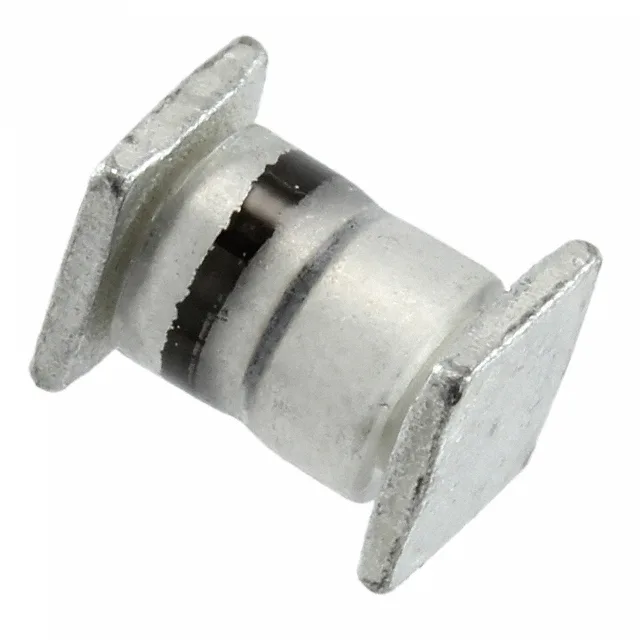
Housed in a SQ-MELF, E case (supplier device package D-5B), a hermetic ceramic surface-mount package with metallized end caps. The SQ-MELF (Surface Mount Qualified MELF) is a cylindrical body with flat sides — it self-centers during reflow and offers better thermal cycling reliability than a standard MELF because the flat sides reduce rolling during solder paste deposition. The D-5B variant is the Microchip specific marking for this outline. Surface mount mounting — the end caps are soldered directly to the PCB pads. The package is rated for the full -65°C to 155°C junction temperature range, so it suits high-reliability and military-temperature applications where a plastic SMD package would delaminate under thermal shock. No exposed metal tab; heat is conducted through the end-cap solder joints and the PCB copper.