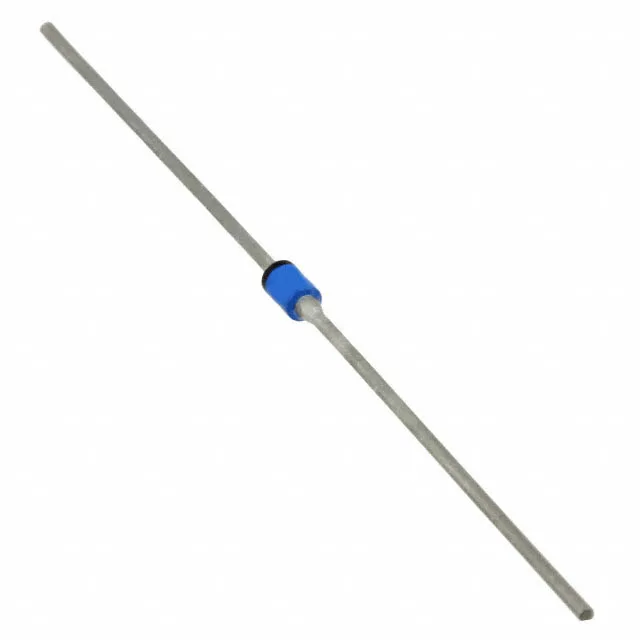
Fast recovery for snubber and flyback duty
The 1N6075/TR is a standard-technology fast recovery rectifier rated for 150 V reverse voltage and 850 mA average forward current, with a 30 ns reverse recovery time that places it well inside the <500 ns boundary for the class. That 30 ns trr makes it a candidate for snubber networks, flyback catch diodes, and freewheeling circuits where the switching node needs to clamp quickly without excessive stored charge.
The 150 V reverse voltage gives it margin on a 48 V or 72 V bus where transients can ring above the rail — the 1 µA leakage at that voltage is low enough to ignore in most bias networks, but doubles roughly every 10 °C rise above 25 °C junction. The 850 mA average current is the DC load limit; the 30 ns trr is the switching-loss figure that matters at frequencies above 50 kHz, where the recovery charge starts to dominate the dissipation. Forward voltage is 2.04 V at 9.4 A pulsed — that is a surge condition, not a steady-state figure. At the rated 850 mA the Vf will be lower, typically around 1.0–1.2 V for a fast recovery diode of this class. The junction temperature range spans -65 to 155 °C, covering military temperature extremes without derating the current below 100 °C case temperature.