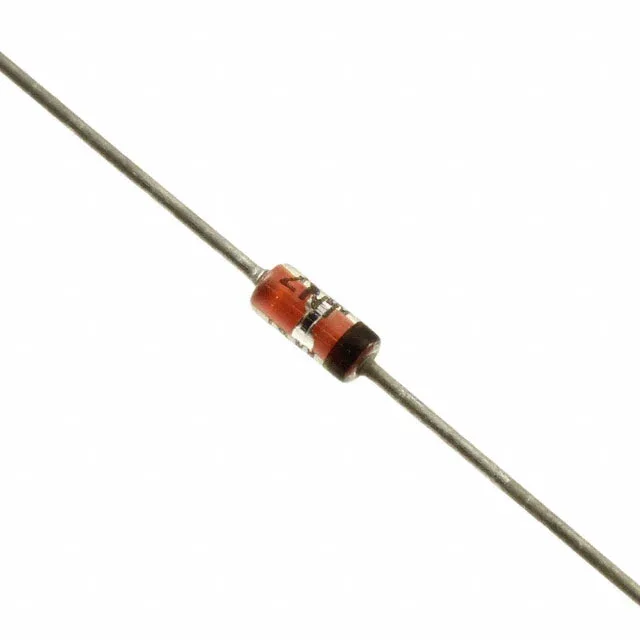
The 1N6028A is a 150 V Zener diode from Microchip Technology, rated for 500 mW continuous power dissipation in the standard DO-35 axial package. The 150 V nominal breakdown point suits it for regulating higher-voltage rails — think 120 VDC bus clamping or series-stacked Zener references — where a lower-voltage part would avalanche prematurely. With ±10% tolerance on the Zener voltage, the actual breakdown sits between 135 V and 165 V. That spread is typical for general-purpose regulation; if your design needs tighter control, a ±5% or ±2% grade would be the next step up. Maximum Zener impedance is 1700 Ohms at the test current — a relatively high value that means the regulation voltage shifts more with load current than a lower-impedance Zener would. For circuits drawing a few milliamps, the voltage drop across Zzt stays manageable; for higher-current loads, the output will sag noticeably.
Through-hole assembly and temperature range
No MSL concern — the glass-passivated die is hermetic, so it skips the moisture bake that plastic packages require before reflow. The 500 mW power limit is derated linearly above 25°C; at 175°C the allowable dissipation drops to near zero, so keep the lead length short and the ambient airflow reasonable if you are running near the power ceiling.
Leakage and forward characteristics
Reverse leakage is specified at 100 nA maximum when 91 V is applied across the junction — that is 60% of the nominal Zener voltage, so the diode stays well into the off region before breakdown. For high-impedance bias networks or sample-and-hold circuits, this low leakage means the stored charge bleeds off slowly. Forward voltage is 1.1 V maximum at 200 mA forward current. That makes the 1N6028A usable as a general-purpose rectifier or clamping diode in a pinch, though its primary role remains Zener regulation.