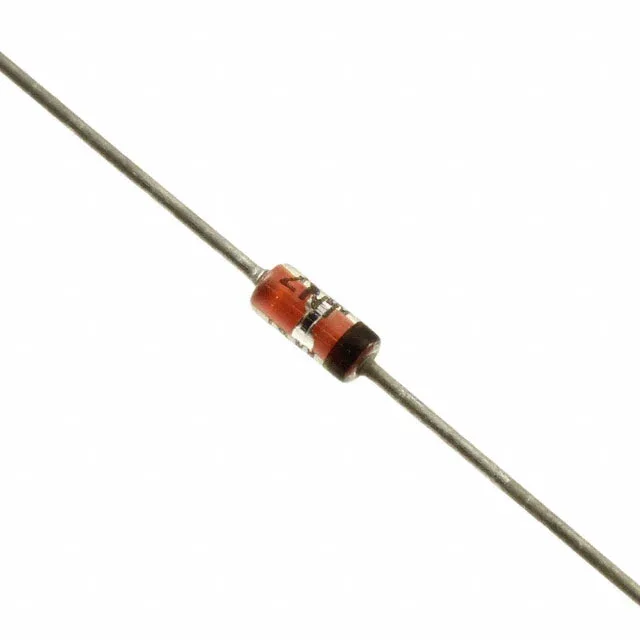
11 V regulation in a DO-35 axial package
The 1N6001B/TR is an 11 V Zener diode from Microchip Technology, rated for 500 mW maximum power dissipation in a through-hole DO-204AH (DO-35) axial-lead package. The ±5% tolerance on the nominal 11 V breakdown means the actual Zener voltage for any given unit falls between 10.45 V and 11.55 V at the specified test current — a band tight enough for most reference and clamping duties in low-power analog and digital circuits.
What the key parametrics mean for your circuit
Maximum Zener impedance (Zzt) is 18 Ohms — this is the dynamic resistance at the nominal breakdown knee. A lower Zzt means tighter voltage regulation as the bias current varies; 18 Ohms is typical for an 11 V, 500 mW device and keeps the output voltage shift under a few hundred millivolts across the operating current range. Reverse leakage current is specified at 100 nA maximum when the applied reverse voltage is 8.4 V — well below the breakdown threshold. This confirms the diode stays effectively open-circuit in the off state, drawing negligible current from the rail it is protecting or referencing. Forward voltage (Vf) is 1.1 V maximum at 200 mA forward current. While the primary use is reverse-breakdown regulation, the forward characteristic matters if the diode sees occasional forward conduction — the 1.1 V drop at 200 mA means 220 mW of forward dissipation, within the 500 mW total power budget. The 500 mW power rating must be derated above 25°C ambient; at 175°C the allowable dissipation approaches zero. For a 500 mW part in a DO-35 package, the thermal resistance junction-to-ambient is roughly 300°C/W, so a 500 mW dissipation raises the junction about 150°C above ambient.
The DO-204AH (DO-35) axial package is a standard through-hole form factor with 0.020-inch diameter leads. It mounts by bending the leads to the required pitch and soldering into plated through-holes. The tape-and-reel packaging suits automated insertion for high-volume assembly, though the part itself is a through-hole device — the reel format feeds axial-lead forming and insertion machines.