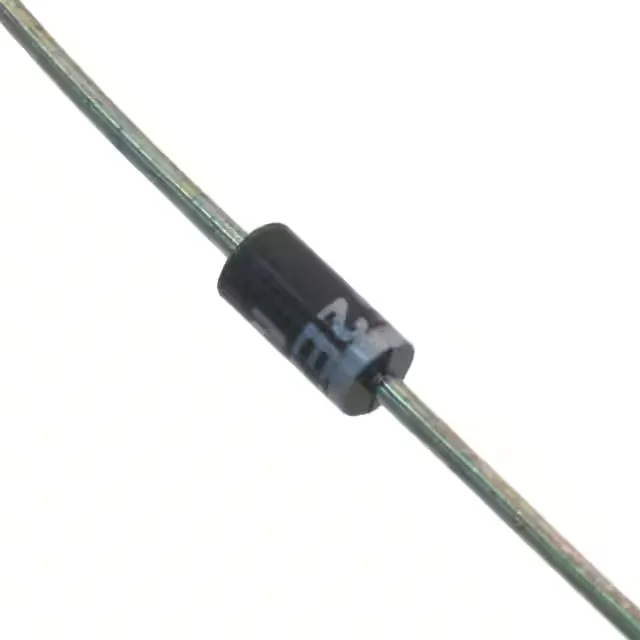
Zener voltage and regulation accuracy
The 1N4734P/TR8: The 5.6 V nominal Zener voltage with ±10% tolerance means the actual regulation point for any given diode falls between 5.04 V and 6.16 V. For a rail that needs tighter than 10% absolute accuracy, a selected or tighter-tolerance part is the safer call. Maximum impedance (Zzt) of 5 Ohms at the test current means the regulation voltage shifts about 5 mV per mA of load current change — a 20 mA swing shifts the output by 100 mV, which is within the tolerance band but worth budgeting in a precision bias supply.
Power dissipation and thermal margin
Rated for 1 W continuous power dissipation in the DO-204AL (DO-41) axial package. At 5.6 V that works out to about 178 mA maximum Zener current — but the real limit is junction temperature, not the current number.
Leakage and forward conduction
Reverse leakage is specified at 10 µA maximum at 2 V reverse bias. That is the off-state current the diode draws before it reaches the Zener knee — negligible for most bias circuits, but worth checking if the load is a high-impedance CMOS input that sees the leakage as an offset. Forward voltage is 1.2 V maximum at 200 mA forward current. When the diode is forward-biased (e.g., in a clamping or protection role), the 1.2 V drop at 200 mA means 240 mW of conduction loss — well within the 1 W budget, but the heat still goes into the same junction.