Zener regulation and power handling
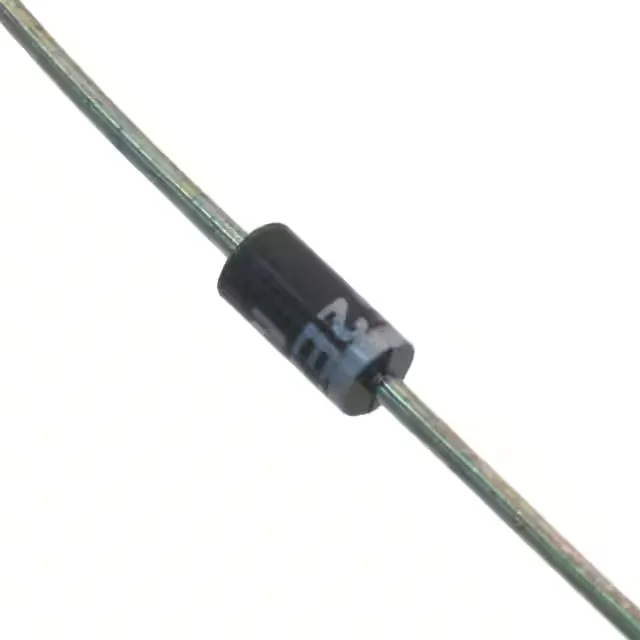
The 1N4734CP/TR12 is a 5.6 V Zener diode in the standard DO-41 axial package, rated for 1 W continuous power dissipation. That 1 W ceiling means the product of Zener voltage and average current must stay at or below 1 W — at 5.6 V, the diode can sink about 178 mA continuously before the junction exceeds the thermal limit, assuming adequate lead length and ambient air. Tolerance is ±2%, which is tighter than the ±5% or ±10% common on general-purpose Zeners. For a 5.6 V nominal part, the regulation window spans 5.488 V to 5.712 V — narrow enough for a precision shunt reference in a bias supply or a protection clamp where the threshold must stay inside the downstream device's abs-max range.
Dynamic impedance and leakage
Maximum Zener impedance (Zzt) is 5 Ohms at the test current. A lower impedance means the Zener voltage shifts less when the load current changes — the 5 Ω figure is typical for a 5.6 V, 1 W part and keeps the regulation steady enough for most analog rail references. If the load steps hard, the voltage swing equals the current step times 5 Ω, so a 10 mA change shifts the output by 50 mV. Reverse leakage is 10 µA max at 2 V reverse bias — well below the Zener knee. This matters in battery-powered or high-impedance circuits where leakage drains the rail; 10 µA at 2 V is negligible for most designs but worth checking if the Zener sits across a high-value pull-up or a micropower supply.
Forward voltage drop is 1.2 V max at 200 mA forward current — a standard silicon diode characteristic. If the part is used in the forward direction for clamping or rectification, the 1.2 V drop at 200 mA adds about 240 mW of dissipation, which counts against the 1 W total power budget.
The Tape & Reel packaging (TR suffix) is the standard reel format for axial-lead diodes, typically 5,000 pieces per reel.